

Views: 0 Author: Site Editor Publish Time: 2026-06-10 Origin: Site


A PVC Pipe project becomes clearer when the product is not treated as one single pipe name. PVC is a material family, and different PVC Pipe type options are developed for different engineering conditions. Some pipes focus on cost-effective water and drainage service, some are made for heat or chemical resistance, some improve water transmission efficiency, and others are designed for tougher cable protection. At andgsm, Hebei Anduan Technology Industry Co., Ltd. provides a complete PVC piping portfolio covering UPVC, CPVC, PVC-O, PVC-M and HPVC, helping municipal, utility, agricultural and industrial customers match the right pipe category to the actual project use.
UPVC stands for unplasticized polyvinyl chloride. Compared with flexible plastic materials, UPVC keeps a rigid structure, which makes it suitable for many common pipeline systems. It is one of the most widely used PVC Pipe type options because it offers a practical balance between corrosion resistance, installation convenience and project cost.
UPVC pipes are commonly used in water supply, drainage, sewer systems, agricultural irrigation, power conduits and telecom ducts. For water and drainage projects, UPVC helps reduce corrosion problems that may appear in metal pipelines. For irrigation systems, it supports large-area water delivery with easier handling. For power and information conduits, it can provide a protective route for cables and communication lines.
At andgsm, UPVC products include options for water pipes, drain pipes, power pipes and information pipes. This makes UPVC a useful general-purpose category for customers who need stable performance without moving into more specialized material requirements.
Long pipe runs need more than material strength. They also require efficient transportation, convenient handling and consistent connection with fittings. UPVC is lighter than many traditional pipe materials, which makes it easier to move and install on site. This is valuable for municipal projects, agricultural fields, building drainage systems and underground utility routes.
Another advantage is cost control. Large projects often require thousands of meters of pipe. A pipe that is too heavy or too expensive may increase both construction cost and logistics pressure. UPVC provides a cost-effective solution while still offering good corrosion resistance and broad application coverage.
andgsm supports standard diameters, pressure classes, color coding, print markings and matching fittings. For customers planning long pipe networks, these details help keep the whole system organized from delivery to installation.
CPVC is chlorinated polyvinyl chloride. It is based on PVC but modified to improve heat resistance and chemical resistance. This makes CPVC different from ordinary PVC categories, especially when the project involves higher temperature conditions or more demanding fluid environments.
The key point is not that CPVC should replace every other PVC Pipe type. Its value appears when the working condition requires stronger resistance to heat or certain chemicals. For normal drainage or basic irrigation, UPVC may already be enough. For power conduit exposed to higher thermal conditions or industrial fluid handling, CPVC can be a better technical fit.
This distinction helps customers avoid overgeneralizing PVC pipes. A pipe used for cold water drainage and a pipe used for industrial fluid service do not face the same environment. CPVC gives engineers another option when the application is more demanding.
At andgsm, CPVC products include CPVC Power Pipe and CPVC Industrial Pipe. CPVC Power Pipe is suitable for power conduit applications where heat resistance and stable protection are important. CPVC Industrial Pipe can be used in industrial fluid handling conditions where ordinary pipe categories may not provide enough resistance.
For industrial customers, the pipe type should be checked according to the transported medium, working temperature, pressure requirement and installation environment. CPVC is especially useful when the pipeline needs both structural stability and improved material resistance.
This makes CPVC a more specialized PVC Pipe type in the andgsm product portfolio. It is not selected only because it is “stronger” in a general sense. It is selected because the project condition requires the benefits that CPVC can provide.
PVC-O means oriented PVC. It is produced through a molecular orientation process that improves the pipe’s mechanical performance. The main advantage of PVC-O is its high strength-to-weight ratio. It can support efficient water transmission while keeping the pipe lighter than many traditional high-strength piping materials.
For water projects, this balance is important. A pipe used in transmission systems must handle pressure, support stable hydraulic performance and remain manageable during transportation and installation. PVC-O is designed to meet these needs in a more efficient way.
andgsm PVC-O Pipe is positioned for water transmission efficiency, with benefits such as hoop strength, impact resistance and hydraulic performance. These qualities make it suitable for water infrastructure where both strength and flow efficiency matter.
PVC-O is especially useful in long-distance water transmission, distribution mains and agricultural irrigation mainlines. These projects require pipes that can carry water over long routes while maintaining reliable pressure performance.
A long water pipeline needs stable internal flow, appropriate pressure capacity and consistent quality along the whole system. PVC-O supports these goals through its material structure and lighter pipe body. This can help reduce handling difficulty and improve installation efficiency in large water projects.
For customers working on municipal water transmission, rural water supply, distribution networks or irrigation mainlines, PVC-O provides a focused solution inside the wider PVC Pipe family. It is not simply another general pipe. It is a category designed around water delivery performance.
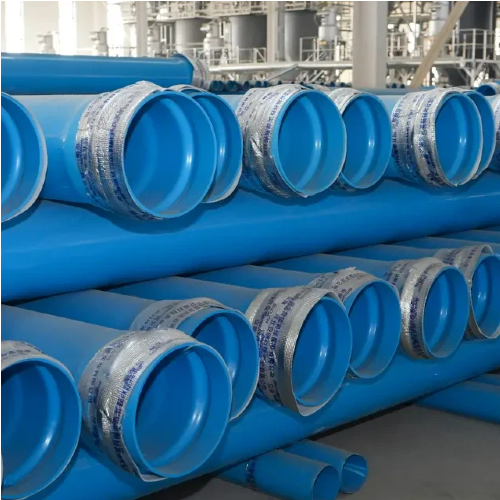
PVC-M means modified PVC. Its main purpose is to improve toughness and impact resistance. This matters because pipes may face impact during transportation, unloading, trench installation or long-term operation. A tougher pipe can help reduce the risk of cracking caused by handling stress or external impact.
PVC-M is useful where a distribution system needs reliable pressure performance but also requires better resistance to physical damage. In real projects, pipes are not only tested after installation. They also go through storage, movement, cutting, connection and backfilling. Toughness helps the pipe perform more reliably across these stages.
andgsm PVC-M Pipe is developed for improved ductility and impact resistance, making it suitable for distribution networks where durability and field handling both matter.
Urban distribution networks often have complex installation conditions. Pipelines may pass through roads, residential areas, service zones and other underground utility routes. During construction, pipes may face limited working space, backfill pressure and possible contact with other infrastructure.
PVC-M can be a practical option for urban water distribution, agricultural irrigation and drinking water delivery systems. Its improved toughness helps support stable service in systems where ordinary pipe impact resistance may not be enough.
For project customers, the main value of PVC-M is not only the material modification itself. The benefit is lower risk during handling and more confidence in pressure distribution applications. This makes it an important part of the andgsm PVC Pipe type portfolio.
HPVC is a high-performance PVC category designed for demanding cable protection and utility corridor applications. Unlike water pipes, HPVC Power Pipe focuses on protecting cables rather than carrying fluid. This means the pipe must provide mechanical protection, internal smoothness, route identification and stable performance in buried or corridor environments.
Power cables and communication lines can be affected by soil pressure, impact, moisture and construction disturbance. A suitable protection pipe helps create a safe path for installation and future maintenance. HPVC is used when the project requires higher stiffness, impact resistance and protection reliability.
andgsm HPVC Power Pipe supports demanding cable protection needs and utility corridor projects. It can be used where ordinary conduit performance may not be enough. Smooth inner walls can help reduce cable pulling friction, while color coding and print markings help distinguish different routes during installation and maintenance.
For power and utility customers, HPVC is a focused solution within the PVC Pipe family. It shows that PVC-based products are not limited to water systems. They can also support electrical infrastructure and communication protection when the pipe is designed for that purpose.
The table below summarizes the main PVC Pipe type options in the andgsm product range.
PVC Pipe Type | Main Strength | Typical Application | andgsm Product Fit |
UPVC | Cost-effective and corrosion-resistant | Water, drainage, irrigation, conduit | UPVC Water Pipe, UPVC Drain Pipe, UPVC Power Pipe |
CPVC | Heat and chemical resistance | Power conduit, industrial fluids | CPVC Power Pipe, CPVC Industrial Pipe |
PVC-O | High strength-to-weight ratio | Water transmission, distribution mains | PVC-O Pipe |
PVC-M | Toughness and impact resistance | Urban distribution, irrigation | PVC-M Pipe |
HPVC | Higher stiffness and cable protection | Utility corridors, power cable protection | HPVC Power Pipe |
This comparison shows why PVC Pipe should be viewed as a product family. Each type has a different purpose. UPVC is suitable for broad utility use, CPVC serves heat and chemical resistance needs, PVC-O improves water transmission efficiency, PVC-M strengthens distribution network toughness, and HPVC supports demanding cable protection.
For customers, the most useful starting point is the project condition. The intended use, operating environment, pressure requirement, temperature condition, cable protection demand and fitting needs all affect the final pipe type. andgsm can recommend a suitable PVC piping system when these details are provided clearly.
Different PVC Pipe type options are designed for different engineering needs, and treating them as one universal product can lead to wrong specifications. UPVC, CPVC, PVC-O, PVC-M and HPVC each serve a clear purpose in water supply, drainage, irrigation, power conduit, telecom duct, industrial fluid handling and utility corridor projects. Andgsm provides a complete PVC piping portfolio with standard diameters, pressure classes, color coding, print markings and matching fittings to help customers match the right system to the right application. To discuss PVC-O Pipe or other PVC-based pipe categories for your project, contact us with your specifications and our team will provide a suitable recommendation with a rapid quotation.
The main PVC Pipe types include UPVC, CPVC, PVC-O, PVC-M and HPVC. Each type is designed for different applications, such as water supply, drainage, irrigation, industrial fluid handling or cable protection.
No. UPVC is commonly used for cost-effective water, drainage, irrigation and conduit systems. CPVC has better heat and chemical resistance, making it more suitable for power conduit and industrial fluid applications.
PVC-O Pipe is used for efficient water transmission, distribution mains and irrigation mainlines. It offers a high strength-to-weight ratio and supports hydraulic performance in water infrastructure projects.
HPVC Power Pipe should be considered for demanding cable protection and utility corridor projects. It is suitable when higher stiffness, impact resistance, smooth cable pulling and clear route marking are required.


