
Views: 0 Author: Site Editor Publish Time: 2026-08-14 Origin: Site


Selecting the proper materials builds the foundation of any resilient plumbing infrastructure. A single material failure can trigger catastrophic leaks, costly repairs, and significant code violations. You must match specific material grades to your exact application needs. Standard pvc pipe carries a firm restriction for cold water and drainage systems. It maxes out at an operating temperature of 140°F (60°C). Exceeding these thermal limits compromises structural integrity instantly.
This guide provides contractors, project managers, and property owners a clear path for evaluating material specs. We will explore sizing metrics, critical compliance standards, and proven strategies for vetting reliable sourcing partners. You will learn how to avoid common pitfalls during installation. Proper planning prevents expensive municipal inspection failures later. Let us examine the technical realities driving modern plumbing decisions.
Match Schedule to Pressure: Schedule 40 is standard for residential residential drainage and cold water, while Schedule 80 is required for high-pressure or industrial commercial applications.
Verify Certifications: Potable water systems mandate NSF/ANSI 61 and NSF/ANSI 14 compliance to guarantee health safety and structural integrity.
Understand Sizing Realities: Nominal pipe size does not equal actual outside diameter (OD); fittings and pipes must share identical sizing systems.
Vet Your Sourcing Partner: Selecting a vetted PVC pipe manufacturer or supplier reduces project delays, ensures batch-to-batch consistency, and provides traceability for compliance audits.
You must understand where plastic materials excel and where they fail. The industry relies heavily on this polymer for two primary applications. First, we use it for cold water distribution. Second, it serves as the backbone for gravity-fed drainage systems. Let us break down these optimal use cases.
Cold Water Distribution: You will find these materials optimal for main supply lines. They work exceptionally well for agricultural irrigation networks. Underground service lines also benefit greatly from their inherent corrosion resistance. Soil acidity does not degrade them over time.
Drainage, Waste, and Vent (DWV): This represents the industry standard for non-pressurized applications. Both residential and commercial buildings depend on these networks to remove wastewater safely. Gravity moves the fluids, meaning internal pressure remains minimal.
Knowing when to avoid a material is crucial for safety. Professionals never compromise on application limits. Ignoring these boundaries invites disaster. We must clearly outline where you should never install standard plastic piping.
Never use these lines for hot water distribution. Temperatures above 140°F cause the walls to soften and rupture. You must use CPVC or cross-linked polyethylene (PEX) for heated applications.
Never use these products for compressed air or gas lines. When pressurized gases cause a rupture, the plastic violently shatters into dangerous shrapnel. Rely on metallic alternatives like copper or galvanized steel for compressed air.
Always differentiate between solid wall and cellular core variants. Solid wall lines handle internal pressure safely. Cellular core variants feature a foam-like center. You must restrict cellular core solely to non-pressure DWV applications.
Sizing confusion ruins many plumbing projects. Novice installers frequently buy incorrect fittings because they misinterpret the labeled dimensions. You must master how the industry measures and categorizes these materials. Let us clarify the critical differences in PVC pipe sizes.
A labeled 2-inch pipe never measures exactly 2 inches across the outside diameter (OD). The industry uses a system called "nominal" sizing. Nominal simply means "in name only." Actual outside diameters follow the Iron Pipe Size (IPS) standard. For example, a nominal 2-inch unit actually measures 2.375 inches across the outside. You must ensure all fittings match the IPS standard precisely.
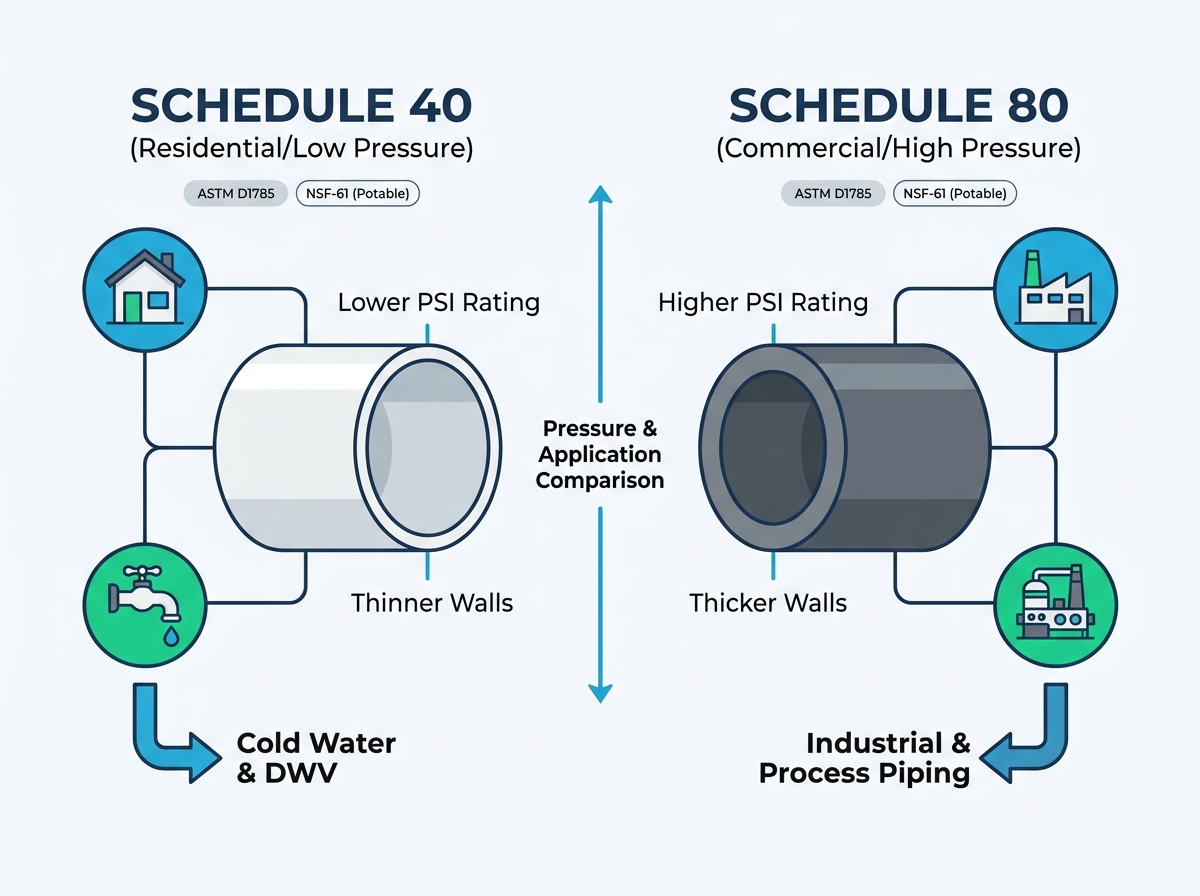
Wall thickness dictates pressure capacity. The industry uses "Schedules" to classify this thickness. The outside diameter remains constant across schedules to ensure fitting compatibility. The inside diameter shrinks as the wall gets thicker. You must review proper PVC pipe specifications before purchasing.
Schedule 40: Manufacturers usually produce these in a solid white color. They feature thinner walls compared to higher schedules. They represent the optimal choice for standard residential water supply and typical DWV installations.
Schedule 80: Manufacturers usually tint these dark gray for easy identification. They feature significantly thicker walls. This extra material handles much higher internal PSI. They represent the optimal choice for commercial, industrial, or high-stress mechanical applications.
SDR represents an alternative sizing system. It differs fundamentally from the Schedule system. In an SDR system, the ratio of the pipe diameter to wall thickness remains constant. Because this ratio never changes, the pressure rating remains identical across all pipe diameters. Common examples include SDR 21 and SDR 26. Municipalities commonly use SDR formats for extensive underground water mains.
Specification Comparison Chart
Specification Type | Wall Thickness | Pressure Rating | Typical Color | Primary Application |
|---|---|---|---|---|
Schedule 40 | Standard | Moderate | White | Residential DWV, Cold Water |
Schedule 80 | Thick | High | Dark Gray | Industrial, Chemical Processing |
SDR (e.g., SDR 21) | Proportional to OD | Consistent across sizes | Varies (often White/Blue) | Municipal Water Mains |
Material testing separates reliable infrastructure from dangerous liabilities. You cannot verify chemical safety just by looking at the plastic. Independent laboratories conduct rigorous testing to ensure these materials perform safely over decades. We rely on strict industry certifications to guide purchasing decisions.
Any line carrying drinking water demands absolute purity. Inferior plastics can leach toxic chemicals into the water supply. You must verify the presence of an "NSF-PW" or "NSF-61" mark printed directly on the exterior wall. The National Sanitation Foundation awards this certification. It guarantees the material produces zero toxic leaching. Never install uncertified plastics for human consumption.
The American Society for Testing and Materials (ASTM) governs physical manufacturing protocols. These codes ensure dimensional accuracy, burst strength, and crush resistance. You should look for specific ASTM codes stamped on the material.
Look for ASTM D1785. This covers standard specifications for Schedule 40, 80, and 120 materials.
Look for ASTM D2665. This dictates standard specifications for drainage, waste, and vent applications.
Contractors sometimes attempt to cut costs using uncertified or gray-market materials. This practice carries enormous financial risks. Local plumbing inspectors check markings during routine site visits. Utilizing uncertified materials leads directly to failed municipal inspections. Failed inspections require costly mandatory tear-outs. Furthermore, uncertified materials frequently void building insurance policies. Water damage caused by an unapproved material becomes your total financial responsibility.
Proper material selection only solves half the puzzle. You must install the network correctly to prevent premature failures. Even the strongest Schedule 80 line will leak if you assemble the joints poorly. We must examine the mechanical realities of modern plumbing installations.
You cannot mix incompatible sizing systems. Standard sizes require exact matching with schedule-appropriate fittings. You primarily choose between two connection types. Slip (or socket) fittings require chemical fusion. Threaded fittings require mechanical twisting and proper sealing tape. If you thread a plastic joint too tightly, the female fitting will crack. Always use transition unions when connecting plastic directly to metal lines.
Joining these materials requires a chemical process, not traditional gluing. Solvent welding actually melts the surface layer of the plastic. When pressed together, the two pieces fuse into one continuous solid piece. You must strictly follow two-step jointing rules.
Apply purple primer to clean and soften the mating surfaces.
Apply the solvent cement immediately after the primer.
Insert the pipe, give it a quarter-turn to spread the cement evenly, and hold it firmly for 30 seconds to prevent push-out.
You must account for environmental conditions. Cold temperatures significantly increase required setting times. High humidity slows the chemical evaporation process. Always consult the cement label for specific curing timetables before pressurizing the newly built network.
Plastic materials react to their physical environment. You must engineer the system to accommodate these natural vulnerabilities. Ignoring these factors leads to bowing, cracking, and eventual catastrophic failure.
Thermal Expansion: Plastic expands and contracts dramatically during temperature swings. Long, straight runs require dedicated expansion loops or mechanical offsets. Without room to expand, the lines will buckle against their restraints and shatter.
UV Degradation: Direct sunlight acts as a slow poison to these polymers. Ultraviolet rays break down the molecular bonds, causing severe brittleness over time. For outdoor above-ground installations, you must apply protective latex paint. Alternatively, you can use specialized UV-resistant wrapping to shield the surface.
Finding the right sourcing partner protects your bottom line. Supply chain delays halt construction progress immediately. Inconsistent batch quality leads to untraceable leaks behind finished walls. We must establish strict criteria for choosing your industrial partners.
A reputable PVC pipe factory operates under stringent quality control protocols. You should verify their ISO 9001 certification. This globally recognized standard proves they maintain consistent manufacturing processes. The best facilities perform in-house hydrostatic pressure testing on every batch. They also employ automated dimensional control systems. Lasers measure wall thickness during extrusion to guarantee perfect uniformity.
Chemical composition dictates structural strength. You must ensure the chosen PVC pipe manufacturer uses 100% virgin resin for all pressure and potable applications. Some cheaper operations mix high ratios of recycled regrind materials into their extrusion hoppers. Regrind materials compromise structural integrity and introduce microscopic weak points. Virgin resin guarantees maximum tensile strength and predictable performance under stress.
Large projects demand dependable logistics. When evaluating a PVC pipe supplier, look beyond base pricing. Inventory depth matters immensely. Can they fulfill an unexpected secondary order within 48 hours? Evaluate their regional logistics capabilities. Prioritize partners who offer transparent lead-times and dedicated delivery fleets. Furthermore, robust technical support documentation helps your engineers resolve complex routing challenges quickly.
Accountability protects your project return on investment. If a defect causes a massive leak, you need a clear path to restitution. Premium manufacturers print clear, highly legible lot codes along the entire length of the product. This traceability facilitates fast compliance audits and pinpoints exact production batches during recalls. Combine this traceability with a robust manufacturer defect warranty. This combination minimizes long-term liability for contractors and property owners.
Successful plumbing infrastructure relies equally on accurate technical specification and trustworthy material sourcing. Understanding exact pressure ratings, compliance marks, and installation chemistry prevents disastrous systemic failures. A well-planned system operates flawlessly for decades when built with certified, high-grade polymers.
Take actionable steps to secure your next project. First, consult closely with site engineers to map exact pressure and temperature requirements. Second, demand complete NSF and ASTM compliance documentation before accepting any deliveries. Finally, request bulk quote estimates from a qualified, ISO-certified manufacturing partner to secure reliable pricing and steady inventory flow.
A: Yes, provided it explicitly carries the NSF-61 certification for potable water. This independent testing guarantees the material will not leach harmful chemicals or toxins into your drinking supply. Always verify the stamp printed directly on the exterior wall before installation.
A: Properly installed and protected from UV exposure and freezing temperatures, standard material is rated to last 50 to 100 years. Its exceptional resistance to internal corrosion and soil acidity ensures remarkable long-term durability in both underground and indoor environments.
A: Standard IPS sizes are the same, allowing them to share outside diameter metrics. However, they use entirely different joining cements and possess completely different thermal ratings. You should never randomly mix them in an active, pressurized hot water system.
A: Underground failures usually occur due to improper bedding and backfill, which places uneven physical stress on the walls. Freezing below the regional frost line without adequate insulation or exceeding the rated PSI limit also causes sudden ruptures.


