
Views: 0 Author: Site Editor Publish Time: 2026-08-04 Origin: Site


Material specification errors in plumbing and industrial piping carry a massive financial burden. A single thermal failure or chemical degradation incident can result in catastrophic leaks. These errors also cause immediate code violations and stall your construction timelines. Standard Polyvinyl Chloride (PVC) and Chlorinated Polyvinyl Chloride (CPVC) often look nearly identical on the job site. They share the same foundational polymer base. However, their specific thermal and chemical tolerances dictate entirely different applications. You must understand these rigid material limits to protect your infrastructure.
This guide provides a strict evaluation framework for selecting the right piping material. We will explore how to match your project specifications directly to the correct polymer. You will learn actionable steps to ensure long-term compliance, optimal system performance, and superior operational safety. By understanding exact temperature thresholds and sizing standards, you can eliminate costly procurement mistakes before installation begins.
Temperature limits dictate the baseline: Standard PVC is rated up to 140°F (60°C); CPVC handles up to 200°F (93°C).
Application differences: PVC is the industry standard for drainage, irrigation, and cold-water systems. CPVC is engineered for hot-water distribution and highly corrosive industrial environments.
Installation compatibility: PVC and CPVC require entirely different primers and solvent cements; they cannot be glued together.
Sizing matters: While standard PVC relies on Nominal Pipe Size (NPS), CPVC often utilizes Copper Tube Size (CTS) for residential applications.
Procurement reality: Sourcing from a verified PVC pipe manufacturer ensures consistent wall thickness and compliance with structural standards, offsetting upfront material costs.
The base polymer contains roughly 57 percent chlorine by mass. Manufacturers expose this base material to chlorine gas and ultraviolet light to create CPVC. This initiates a highly controlled free-radical substitution reaction. The process replaces various hydrogen atoms along the carbon backbone. It utilizes additional chlorine atoms instead. The final product contains up to 74 percent chlorine by mass. This fundamental alteration on the molecular level drastically increases heat resistance. It also improves the overall tensile strength under extreme physical conditions.
Standard materials lose structural rigidity as internal fluid temperatures rise. Engineers refer to this phenomenon as the derating factor. A standard pipe rated for high pressure at room temperature will not maintain that rating as it heats up. Its pressure capacity drops sharply as the fluid nears its maximum thermal threshold. You must observe hard data limits during system design. Standard polymers operate safely only up to 140°F (60°C). CPVC maintains its pressure handling capacity much longer. It safely accommodates fluid temperatures up to 200°F (93°C).
Plastics expand when heated. CPVC possesses a higher coefficient of thermal expansion compared to many traditional metals. Long commercial plumbing runs require specific engineering considerations. Installers must incorporate expansion loops or specialized offsets. These mechanical mechanisms absorb the linear expansion safely. They prevent the pipes from buckling, warping, or snapping at the cemented joints.
Feature | Standard Polyvinyl Chloride | Chlorinated Polyvinyl Chloride |
|---|---|---|
Maximum Operating Temperature | 140°F (60°C) | 200°F (93°C) |
Chlorine Content by Mass | Approximately 57% | Up to 74% |
Common Visual Identifiers | White, Dark Gray | Cream, Off-White, Orange Stripe |
Thermal Expansion Risk | Moderate | High (Requires Expansion Loops) |
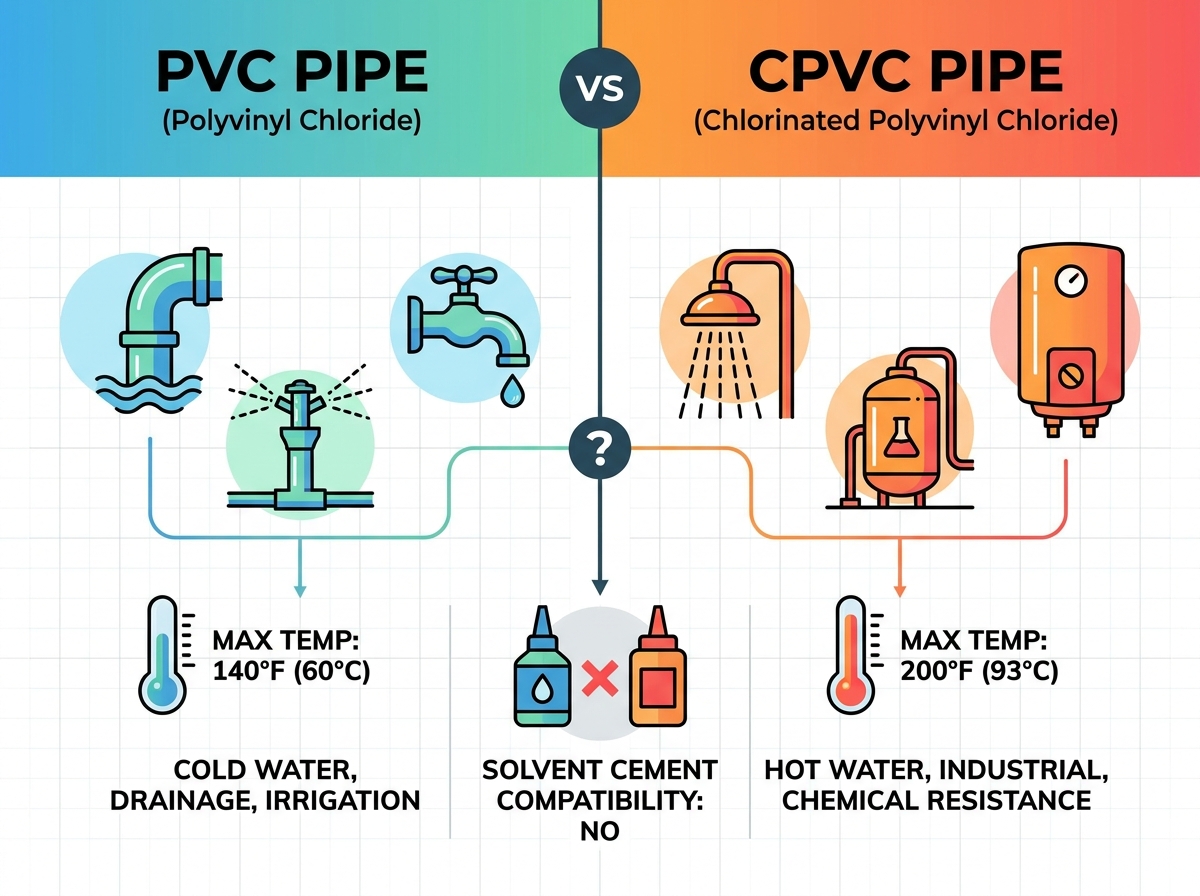
Cost and cold-water efficiency define where standard options win. Drain, Waste, and Vent (DWV) systems universally rely on this economical polymer. Irrigation networks, agricultural supply lines, and underground cold-water mains also benefit heavily from it. The decision logic remains straightforward for contractors. You should always avoid over-engineering your systems. If the network operates strictly under 130°F, you do not need expensive specialized materials. As long as aggressive chemicals remain absent, standard pvc pipe serves as the most cost-effective choice. It handles neutral water and soil applications flawlessly.
Heat and harsh chemical environments dictate where CPVC becomes non-negotiable. Commercial and residential hot water distribution mandates higher thermal thresholds. Industrial chemical processing plants rely on it daily. These facilities handle highly corrosive acids, bases, and aggressive salts. Fire suppression systems also utilize specifically listed chlorination variants. These highly engineered variants carry distinct UL listings for light hazard occupancies.
You must always verify local plumbing codes before finalizing project specifications. The Uniform Plumbing Code (UPC) and the International Plumbing Code (IPC) outline strict installation rules. You must verify all material certifications for specific use cases. Look for the NSF 61 certification before installing any potable water lines. Ensure the materials pass all relevant ASTM standard verifications.
Review the maximum peak temperature of the system, not just the average operating temperature.
Consult the manufacturer’s chemical resistance chart before routing aggressive industrial fluids.
Ensure fire suppression materials carry the explicit NFPA 13D or 13R listing.
Conducting a physical audit of existing structures requires careful observation. Standard color coding helps contractors identify different materials quickly. Standard options typically appear white or dark gray in the field. The chlorinated counterparts often look cream, off-white, or feature a distinct orange stripe along the side.
Follow these steps to conduct an accurate physical audit:
Clean the exterior surface thoroughly to reveal the printed manufacturing codes.
Identify the specific ASTM standard designation printed along the side wall.
Measure the exact outer diameter to confirm the underlying sizing system.
Inspect the molded markings on all attached transition fittings.
You must clearly understand Copper Tube Size (CTS) and Nominal Pipe Size (NPS). Industrial systems generally use the NPS system. Residential retrofits often utilize the CTS system. CTS matches the exact outer diameter of traditional copper plumbing lines. This precise sizing allows seamless residential upgrades. We must also break down standard PVC pipe sizes and structural schedule ratings. Schedule 40 features a thinner wall. It serves perfectly for lower-pressure residential applications. Schedule 80 features a notably thicker wall. The increased wall thickness handles much higher internal industrial pressures. However, this thicker wall slightly restricts the internal flow rate.
Guide your procurement teams carefully during the purchasing phase. They must match all PVC pipe specifications directly to the project’s operational pressure maximums. Accurate specifications prevent premature system blowouts. They also ensure you meet the required flow rates without over-pressurizing the network.
Chemical bonding relies on very specific molecular interactions. The solvent cement actually melts the top molecular layer of the plastic. The two adjoining pieces then fuse together into a single continuous piece. This process requires highly material-specific solvents. You face severe structural failure risks if you use standard glue on chlorinated polymers. The chemical makeup of the cements differs drastically. You absolutely cannot mix them.
Environmental factors heavily influence your installation timelines. Ambient temperature alters the chemical reaction speed of the solvent cement. High ambient humidity levels slow down the evaporation of the solvent carriers. Installers must wait longer before safely pressurizing the system. Failing to observe proper curing times results in immediate joint leaks.
Cutting and handling procedures also vary significantly. Standard materials become highly brittle in sub-zero freezing temperatures. A simple drop from a ladder can shatter the ends. Installers must use specialized cutting tools to avoid microscopic cracking. CPVC offers slightly better impact resistance in cold climates. This physical durability directly impacts your winter construction schedules and reduces material waste.
Skipping the chamfering process, which scrapes the cement out of the fitting socket.
Applying too much primer, causing the chemical to pool and weaken the internal plastic walls.
Failing to hold the joint together for 30 seconds, allowing the pipe to push out of the fitting.
Quality assurance matters immensely in industrial manufacturing. A premium PVC pipe factory utilizes strict virgin resin sourcing. It maintains tightly controlled extrusion cooling processes. It conducts comprehensive batch testing to ensure uniform strength. A low-tier extruder often cuts corners on wall thickness tolerances. These slight manufacturing defects lead to catastrophic failures under high pressure.
Partnering with a reliable PVC pipe supplier protects your demanding construction timeline. Large-scale commercial developments require massive inventory depth. You need highly consistent lead times to keep labor crews moving. You demand strict dimensional consistency across thousands of feet of material. Working directly with a verified PVC pipe manufacturer provides direct access to critical technical support. It guarantees full compliance with local structural standards.
Compare the upfront material premium of advanced polymers against your long-term return on investment. High-demand fluid environments degrade cheaper materials rapidly. You must avoid false economies during the procurement phase. Buying substandard materials creates immediate budget savings but guarantees massive future replacement costs. Invest in quality extrusion products to secure your infrastructure's ultimate longevity.
Selecting the correct piping material requires a strict evaluation of your project demands. You must weigh thermal peaks, chemical exposure levels, and specific sizing standards before making a final procurement decision. Relying on visual identification alone often leads to catastrophic installation errors. By matching precise polymer capabilities to your engineering blueprints, you ensure durable, code-compliant infrastructure.
Evaluate your peak temperature and chemical exposure limits thoroughly before purchasing materials.
Standardize your structural sizing metrics based on the specific NPS or CTS project requirements.
Audit your supply chain partners to guarantee consistent dimensional quality and strict code compliance.
Verify that your primers and solvent cements match the exact polymer type to prevent joint failures.
Encourage your specifiers and contractors to request detailed technical data sheets. Consult with your dedicated engineering teams to review system demands. Reach out to our technical sales team today to secure a custom material quote for your next major installation.
A: No. They require different solvent cements. Connecting them requires specific mechanical threaded adapters or transition fittings.
A: Not necessarily. CPVC is superior for heat and specific chemicals, but it is more expensive. Standard PVC is better suited and more economical for irrigation, drainage, and cold water.
A: It depends. While industrial CPVC uses the same NPS (Nominal Pipe Size) system as PVC (Schedule 40/80), residential CPVC often uses the CTS (Copper Tube Size) system, meaning their outer diameters will not match standard PVC.
A: Yes, provided the pipe and the solvent cement used are both NSF-61 certified for potable water and it is strictly for a cold-water line.


