
Views: 0 Author: Site Editor Publish Time: 2026-08-10 Origin: Site


Selecting materials for large-scale infrastructure requires extreme precision. Modern piping networks form the hidden arteries of our built environment. Engineers and procurement heads face a complex operational decision every single day. Selecting the correct structural piping goes beyond simply evaluating upfront material cost. It demands carefully balancing installation efficiency, long-term lifecycle expenses, and strict regulatory compliance. You must fight constant battles against fluid friction loss, unpredictable soil settling, and aggressive chemical exposure. A single specification error can trigger catastrophic system failures or massive remediation expenses years later. We designed this comprehensive guide to help you navigate these demanding operational environments safely. Our primary goal is to provide project managers, procurement heads, and engineers an evidence-based framework. You will learn how to evaluate pvc pipe solutions across entirely distinct applications. We will explore how to match specific performance metrics to environmental demands. You will also discover robust strategies for auditing your supply chain effectively.
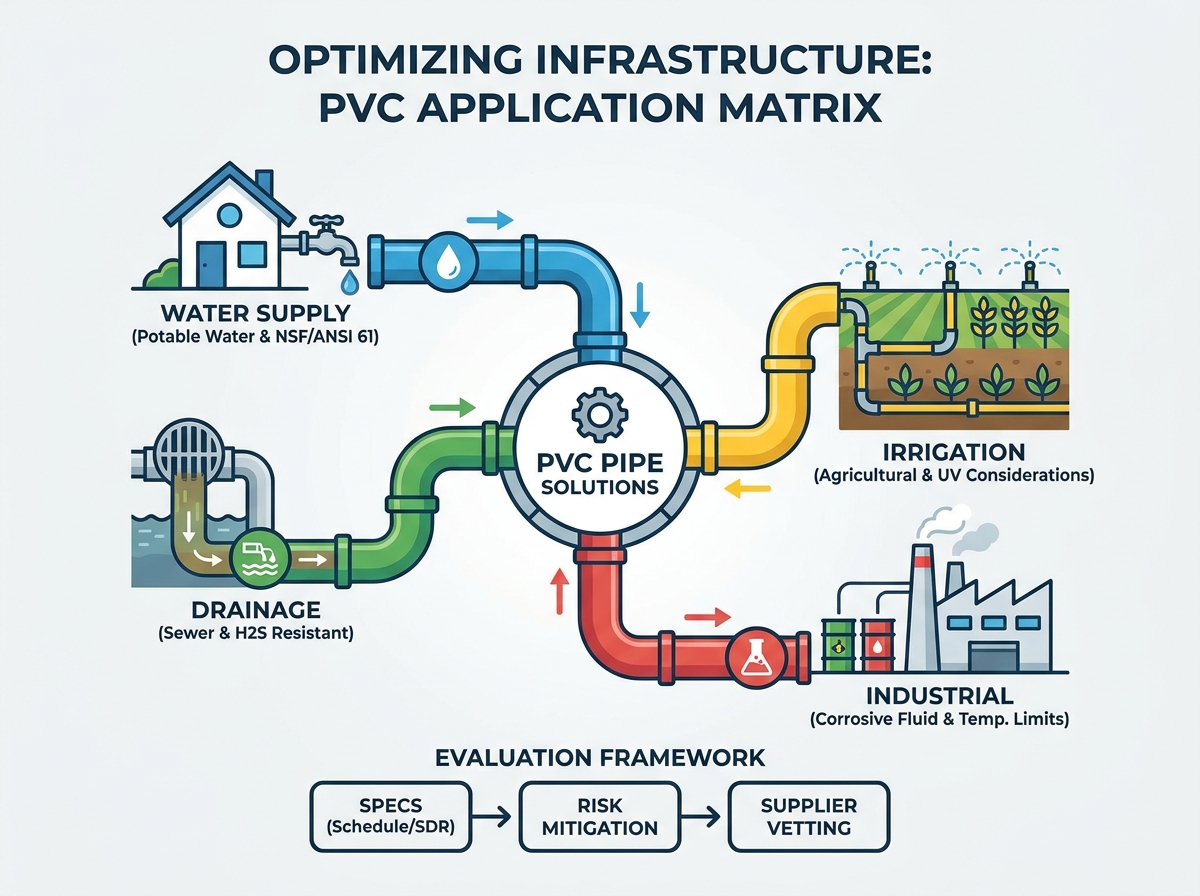
Application-Specific Metrics: Success relies on matching precise PVC pipe specifications (Schedule, SDR, pressure class) to the exact demands of water supply, drainage, or industrial fluid transfer.
Risk Mitigation: Understanding the limitations of PVC—such as temperature ceilings and UV degradation—is critical for preventing systemic failures in industrial and above-ground irrigation setups.
Supplier Due Diligence: Partnering with a vetted PVC pipe manufacturer ensures consistent batch quality, adherence to ASTM/ISO standards, and reliable supply chain logistics for large-volume rollouts.
Municipalities face heavy pressure to ensure the safe, uninterrupted delivery of potable water. They also need to minimize pumping expenses and prevent dangerous bio-film buildup inside the distribution mains. Bio-film creates serious public health hazards and degrades water quality over time. We rely on strict regulatory frameworks to guarantee community safety and infrastructure reliability.
You must verify zero chemical leaching before installing any distribution network. We recommend strictly following mandatory requirements for NSF/ANSI 61 and AWWA standards. Evaluating PVC pipe specifications against these benchmarks ensures public safety.
Demand independent laboratory testing documentation for all production batches.
Verify NSF/ANSI 14 compliance to guarantee baseline structural integrity.
Ensure AWWA C900 certification for all underground municipal delivery systems.
Energy consumption often dominates municipal operating budgets. Assessing the Hazen-Williams C-factor reveals massive long-term energy savings. Standard municipal polymer pipes typically boast a C-factor of 150. This exceptionally smooth interior dramatically reduces friction loss compared to aging iron mains. Pumping stations work less intensely, saving substantial electricity over a fifty-year lifespan. The inner walls resist scaling, meaning the hydraulic efficiency remains constant decades after installation.
Proper system design remains essential to prevent catastrophic fatigue. Water hammer fatigue at joints poses a massive risk in high-pressure delivery systems. You must engineer proper thrust blocking and surge protection. Sudden valve closures send immense shockwaves traveling through the water column. Unprotected joints will inevitably fracture under these extreme stress spikes.
Managing corrosive wastewater presents highly unique engineering challenges. Municipal engineers must actively prevent groundwater infiltration and internal exfiltration. Traditional materials like concrete or cast iron degrade rapidly in these harsh subterranean environments. They suffer from severe microbial-induced corrosion, requiring expensive relining campaigns.
Engineers must carefully balance wall thickness against burial depth. Utilizing Standard Dimension Ratio (SDR) guidelines solves this structural challenge effectively. The SDR dictates the system's ability to withstand external soil loads and vehicular traffic overhead. Deep trenches require thicker walls to resist extreme crushing forces. Choosing the correct SDR prevents pipe deflection and maintains proper gravity flow gradients.
Corrosive gases quickly destroy traditional sewer infrastructure. Anaerobic bacteria generate hydrogen sulfide (H2S) gas within the effluent stream. This gas converts into highly concentrated sulfuric acid inside the sewer crowns. Extensive field evidence supports the extreme chemical resistance of thermoplastic networks. They simply do not rust, pit, or scale when exposed to H2S or sulfuric acid.
Successful deployment depends heavily on precise ground preparation. Shifting soil conditions constantly threaten rigid underground networks. Installation crews must follow strict bedding protocols.
Excavate the trench to provide continuous, uniform support along the entire barrel length.
Place and carefully compact granular bedding material to prevent dangerous point-loading.
Utilize high-quality elastomeric seal joints to accommodate minor seismic or ground movements.
Conduct careful, phased backfilling to maintain a completely leak-proof network over time.
Modern farming operations must deploy scalable, cost-effective water distribution across vast agricultural acreage. Farm managers also have to manage severe environmental wear constantly. Direct sunlight, extreme temperature swings, and heavy farm equipment continually stress the irrigation infrastructure. Efficient water delivery directly impacts crop yields and operational profitability.
Optimizing water velocity requires a highly systematic engineering approach. You must cascade pipe diameters correctly from the central water source down to the specific field zones. Navigating PVC pipe sizes efficiently prevents destructive velocity spikes. High-pressure mainlines demand larger diameters to handle maximum flow rates safely. As water branches out into sub-mains and lateral lines, engineers systematically step down the internal dimensions. This cascading method maintains ideal pressure profiles across the entire farm.
We must maintain transparent assumptions regarding intense UV exposure. Standard formulations handle direct ultraviolet sunlight poorly over extended periods. The polymer chains degrade, and the material eventually becomes dangerously brittle. Long-term viability requires specialized UV-inhibiting additives or protective underground trenching. Painting above-ground sections with a compatible, light-colored latex paint can also shield the infrastructure from solar degradation.
Comparing lifecycle expenses reveals clear structural advantages. A fixed underground grid demands higher initial capital investment and excavation labor. However, temporary surface irrigation solutions incur massive, recurring seasonal labor expenses. Buried networks protect the critical assets from environmental degradation, freezing temperatures, and devastating farm machinery impacts.
Irrigation Pipe Sizing Matrix
Application Zone | Typical Diameter Range | Flow Velocity Target | Primary Function |
|---|---|---|---|
Source Mainline | 8" - 12" | < 5 ft/sec | Bulk water transport from pump station |
Sub-Main Manifold | 4" - 6" | < 5 ft/sec | Distribution to specific crop blocks |
Lateral Lines | 1" - 3" | < 5 ft/sec | Direct supply to sprinkler heads or drip tape |
Heavy manufacturing environments routinely transport harsh chemicals, abrasive slurries, or heated process water. Safely handling these volatile fluids without suffering unplanned downtime remains non-negotiable. Chemical leaks threaten facility worker safety and instantly trigger massive environmental agency fines. System reliability dictates overall plant productivity.
We must offer a highly honest assessment of standard temperature boundaries. Standard polymer materials safely handle process fluids up to 140°F (60°C). Exceeding this thermal boundary compromises the fundamental structural integrity of the network. Engineers must apply strict pressure derating factors when operating at elevated temperatures. As the fluid temperature rises, the maximum allowable internal pressure drops significantly.
Ideal industrial use cases include cooling tower water circulation and low-pressure chemical dosing lines. These specific environments leverage exceptional chemical resistance against chlorine and caustics. However, scenarios involving highly elevated temperatures or extreme pressure surges require alternative materials. Handling highly aggressive industrial solvents might necessitate heavily lined steel or specialized CPVC formulations.
High-stress industrial corridors demand robust, integrated safety margins. Integrating mechanical pressure-relief valves prevents explosive ruptures during unexpected system surges. Maintenance teams should also perform routine ultrasonic thickness testing on critical junctions. This non-destructive technique tracks internal abrasion rates in heavy slurry lines, allowing teams to replace worn sections before catastrophic failure occurs.
Operating Temperature (°F) | Operating Temperature (°C) | Pressure Derating Multiplier |
|---|---|---|
73°F | 23°C | 1.00 (Full Rating) |
90°F | 32°C | 0.75 |
110°F | 43°C | 0.51 |
140°F | 60°C | 0.22 (Maximum Limit) |
Procurement teams must audit a PVC pipe factory far beyond simple base pricing. Cheap, unverified materials often hide terrible quality control practices. Systemic field failures cost exponentially more than any initial procurement savings. You need a comprehensive evaluation framework to separate reliable partners from risky vendors.
A genuinely reliable PVC pipe manufacturer maintains exceptionally rigorous testing protocols. You should actively verify their raw material tracking and blending systems. Ask for extensive documentation regarding continuous hydrostatic burst testing. The production facility must perform strict dimensional tolerance checks continuously during the extrusion process. Microscopic wall thickness variations lead directly to catastrophic joint failures under pressure.
Specialized municipal or industrial infrastructure often requires highly unique engineering solutions. Assess whether the facility can reliably produce exact custom specifications. Requesting non-standard custom lengths drastically reduces the required joint counts in massive linear runs. Fewer physical joints translate directly to fewer potential leak points over the system's lifespan.
Large-volume infrastructure rollouts require absolutely flawless logistics. Evaluating the geographic footprint and delivery capabilities of your PVC pipe supplier remains paramount. You need highly staggered, strictly on-time site deliveries. Truck deliveries must align perfectly with your phased construction schedules. Delayed shipments idle expensive heavy machinery and drastically inflate your daily labor budgets.
Match Specifications to Reality: Successful deployment fundamentally requires aligning harsh environmental realities with exact material specifications. Never guess on SDR or Schedule ratings.
Prioritize Rigorous Vetting: Optimizing long-term investment starts with strict supplier selection. Demand verifiable, third-party product data before signing procurement contracts.
Design for Safety: Always integrate pressure-relief mechanisms and surge protection in high-risk industrial or municipal water delivery networks.
Next Steps: We encourage procurement teams and facility engineers to request a comprehensive technical consultation today. Submit your system schematics for a professional specification review, or contact our engineering desk to request a detailed volume quote tailored to your exact project parameters.
A: Reference established calculation frameworks using your required flow rate and strict velocity limits (typically capping at 5 ft/sec). Combine these figures with your maximum operating pressure to select the appropriate Schedule (such as Schedule 40 versus Schedule 80) or the required Standard Dimension Ratio (SDR) for your specific industrial application.
A: The critical differences lie primarily in standard jointing methods and material rigidity. Standard drainage networks utilize solvent weld or elastomeric gasket joints, offering high rigidity in trenches. Conversely, HDPE relies on thermal fusion jointing and provides high flexibility, which helps when navigating irregular trench paths or highly unstable soil conditions.
A: You should formally request updated documentation regarding their ISO 9001 certification. Furthermore, demand comprehensive lot traceability records and independent, third-party laboratory testing results for your specific product batch. This ensures the facility actually follows stated testing protocols during extrusion.
A: Standard formulations handle UV exposure poorly over time, eventually becoming brittle. However, specific formulations exist that incorporate titanium dioxide to resist solar radiation. Alternatively, painting standard exposed pipes with water-based latex paint can effectively mitigate this degradation risk.


