
Views: 0 Author: Site Editor Publish Time: 2026-10-27 Origin: Site


Upgrading underground power grids in crowded urban environments presents a highly complex engineering challenge. Construction teams must navigate dense subsurface infrastructure without disrupting surface traffic or daily life. Horizontal directional drilling (HDD) solves this challenge effectively. It allows engineers to install utilities by avoiding surface excavation entirely. However, this trenchless installation method subjects conduits to intense mechanical stress.
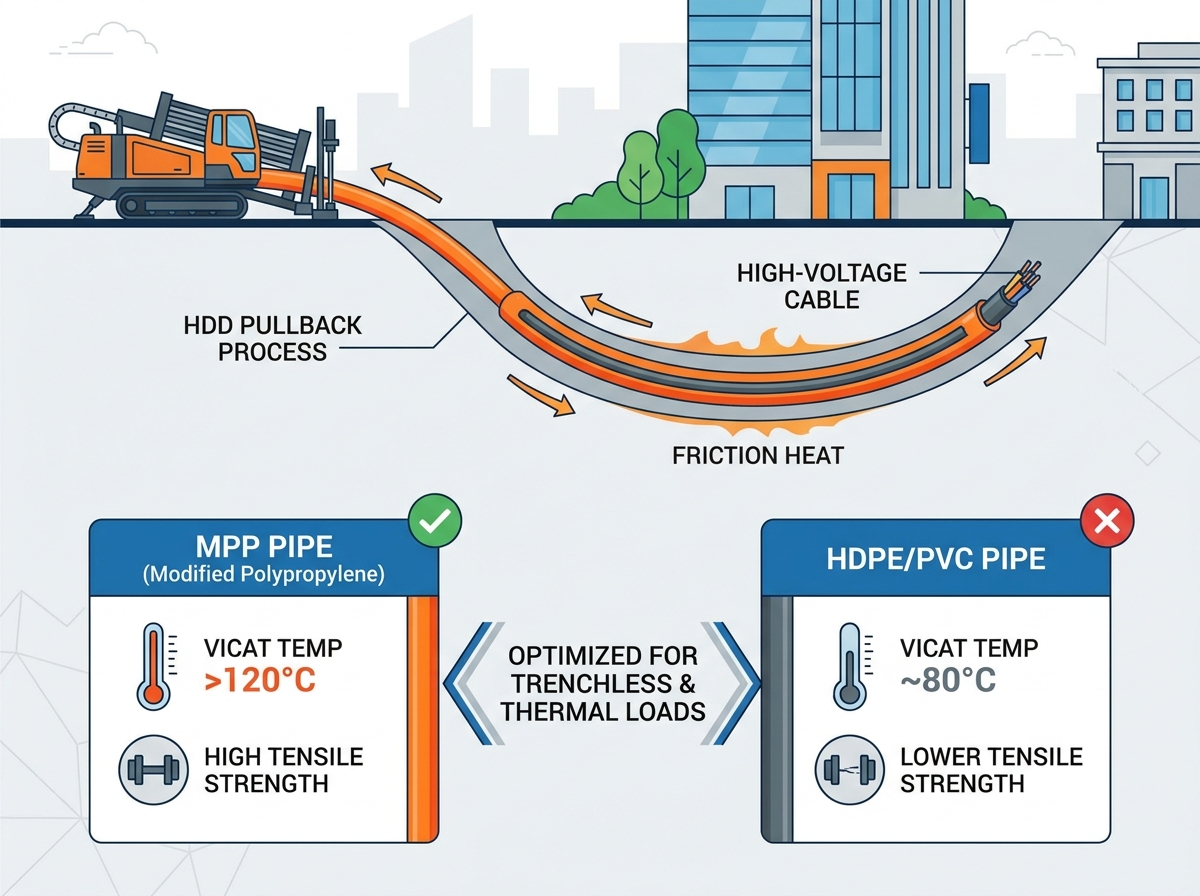
Heavy pullback friction against surrounding soil creates immense external heat. Simultaneously, high-voltage cables generate significant internal operational heat. This dual threat of external friction and internal thermal load easily overwhelms standard plastic conduits. It often leads to catastrophic conduit failure or severe electrical hazards. Modified Polypropylene (MPP) provides a proven, highly engineered solution. Manufacturers developed this advanced polymer specifically to handle extreme thermal and mechanical stressors. It maintains deep structural integrity under intense loads. MPP serves as the necessary industry standard where conventional options simply fail. In this article, you will discover the rigorous engineering criteria for selecting underground conduits. We will explore precise installation protocols and outline crucial quality control measures. These insights will help you ensure your next critical infrastructure project succeeds safely.
Thermal Superiority: MPP withstands continuous temperatures up to 120°C, preventing conduit deformation from both HDD friction and high-voltage power loads.
Tensile Reliability: High tensile yield strength mitigates the risk of pipe snapping during long-distance trenchless pullback operations.
Installation Precision: Successful MPP pipe installation requires strict adherence to hot-melt welding temperature and cooling protocols to ensure joint integrity.
Vendor Due Diligence: Procuring reliable MPP requires verifying virgin resin content, as recycled additives severely compromise ring stiffness and lifespan.
Horizontal directional drilling generates intense external temperatures. During the final pipe pullback phase, the heavy drill head drags the conduit through dense soil, abrasive sand, and jagged rock. This high-friction environment rapidly heats the exterior pipe surface. Standard plastics easily soften and warp under these severe geological conditions. When a pipe deforms mid-pull, you risk losing the entire bore path.
Internally, high-voltage transmission lines carry massive electrical loads. These thick cables operate continuously within tightly confined underground spaces. They emit substantial radiant heat due to inherent electrical resistance. The surrounding conduit must trap and safely manage this continuous thermal load. It must accomplish this without melting, losing its circular shape, or compromising the surrounding soil bed.
Material comparison quickly reveals why engineers prefer MPP power pipe. High-density polyethylene (HDPE) works exceptionally well for standard water and low-voltage piping. However, HDPE possesses a relatively low softening point around 80°C. Polyvinyl chloride (PVC) is even more vulnerable to heat and sudden impact. In sharp contrast, MPP boasts a Vicat softening temperature exceeding 120°C. This makes it ideal for high-stress applications.
Table 1: Thermal and Mechanical Comparison of Conduit Materials
Material Type | Vicat Softening Temp (°C) | Tensile Strength | Primary Application Suitability |
|---|---|---|---|
Standard PVC | ~75°C - 80°C | Low to Medium | Shallow burial, low-voltage lines |
HDPE | ~80°C - 90°C | High | Water mains, standard telecom |
MPP (Modified PP) | > 120°C | Very High | High-voltage trenchless grids |
This superior thermal threshold completely prevents mid-installation deformation. It establishes MPP as the mandatory material specification for modern, high-capacity trenchless power distribution projects.
You must evaluate several critical metrics before specifying a conduit. These physical criteria dictate exactly how well the pipe will perform deep underground. Skipping these checks leads to costly infrastructure failures.
Vicat Softening Temperature stands as the primary evaluation metric. It reliably verifies the heat resistance capabilities of your MPP cable protection pipe. A certified testing laboratory must validate this temperature rating. High values confirm the material will endure continuous high-voltage heat without softening.
Ring stiffness and compression strength dictate long-term structural integrity. You must carefully evaluate the pipe's ability to resist external soil compaction. Once installed, it must withstand heavy surface traffic loads over decades. Proper ring stiffness ensures the pipe avoids structural deflection and maintains cable clearance.
Tensile yield strength assesses the material's threshold for intense pulling forces. HDD rigs exert massive torque and drag. High tensile strength prevents material necking. It guarantees the pipe will not dangerously stretch or snap during rigorous, long-distance pullback operations.
Electrical insulation resistance confirms necessary dielectric strength. High-voltage lines require completely safe containment. Adequate insulation prevents stray electrical arcing. It effectively protects nearby metal infrastructure, water mains, and telecommunications equipment from unexpected electrical faults.
Finally, you must calculate the Wall Thickness to Diameter Ratio (SDR). Selecting the correct SDR specification depends entirely on burial depth and local soil mechanics.
Deeper installations require lower SDR ratings for thicker walls.
Rocky soils demand extra thickness to prevent point-load gouging.
Urban environments under heavy traffic need robust SDR profiles to handle dynamic compression.
Proper field execution actively minimizes catastrophic failure risks. A successful MPP pipe trenchless installation requires strictly phased deployment protocols. Even the best materials fail if operators ignore basic installation mechanics.
Thorough pre-installation inspection catches manufacturing defects early. Field engineers must validate pipe ovality and check wall thickness consistency using calibrated micrometers. They must also visually inspect surface integrity prior to deployment. Deep gouges or scratches compromise the pipe before drilling even begins.
Hot-melt butt welding protocols require rigorous, unwavering oversight. Field crews join individual pipe sections together on-site. Any flaw in this process ruins the conduit's tensile strength.
Operators must maintain precise heating plate temperature control, typically set between 200°C and 220°C.
Under-heating creates weak, brittle cold joints prone to snapping.
Over-heating causes severe polymer chain degradation and ruins joint stability.
Crews must enforce strict, uninterrupted cooling times while keeping the newly formed joint under steady axial pressure.
Calculating the precise drill path trajectory actively prevents mechanical stress fractures. Engineers determine the safest turning radius based directly on pipe diameter. They plot bore bends carefully to keep the polymer matrix fully intact. Pushing beyond the recommended bend radius invites immediate structural failure.
During rigorous pullback operations, crews must carefully manage drill mud viscosity. Bentonite mixtures reduce abrasive friction against the pipe walls. Operators actively control horizontal pull speed to prevent excessive heat buildup. Using specialized breakaway swivels protects the entire conduit assembly from dangerous tensile spikes. Consistent, smooth pulling motions remain central to a flawless MPP pipe installation.
Sourcing materials often presents hidden project pitfalls. The recycled resin risk currently plagues the global plastics industry. Unscrupulous suppliers sometimes blend cheaper recycled plastics with virgin resin. They do this simply to cut manufacturing costs. Unfortunately, this practice drastically reduces essential impact resistance. It heavily degrades the vital thermal stability of your underground MPP pipe. You must actively police material sourcing.
Field engineers can utilize simple visual and tactile indicators to baseline pipe quality quickly.
Inspect the surface texture carefully. Genuine virgin MPP feels consistently rigid, dense, and perfectly smooth.
Check the material's acoustic resonance. High-quality pipe produces a distinct, solid sound when struck firmly.
Test external durability. A premium pipe shows excellent resistance to minor fingernail scoring and surface scratching.
You must rely entirely on standardized compliance to guarantee safety. Always require vendors to prove strict adherence to recognized industry standards. ISO guidelines or specific regional power grid certifications provide reliable, objective benchmarks. These standards verify accurate material composition. They also ensure precise dimensional tolerances for every batch. Never accept shipments without reviewing independent compliance documents first.
Deploying large-scale electrical infrastructure requires highly careful vendor selection. Evaluating a manufacturer's true production capabilities is your most critical procurement step. You must look beyond standard sales brochures to ensure long-term project success.
First, comprehensively assess their factory extrusion line technology. Modern, automated equipment guarantees much better batch-to-batch consistency. It ensures every single MPP electrical conduit exactly meets your strict dimensional specifications. Next, you must relentlessly request independent, third-party testing reports. You need verified laboratory data for Vicat softening points and tensile strength tests. Relying solely on internal manufacturer claims introduces unnecessary project risk.
Structuring a highly detailed Request for Proposal (RFP) sets clear expectations early. Your RFP must explicitly define all required compliance documentation and specific quality standards. You should include firm demands for physical sample testing prior to authorizing any bulk shipping. Furthermore, you must precisely detail your delivery logistics. Active urban construction sites require perfectly timed deliveries to avoid stalling expensive HDD crews. Clear, rigorous communication with your chosen manufacturer guarantees a seamless, delay-free supply chain.
Specifying MPP Pipe is fundamentally a vital risk-management decision for critical underground infrastructure. Modernizing dense urban power grids demands advanced materials. These conduits must comfortably tolerate extreme heat and endure immense abrasive friction. MPP delivers this necessary, uncompromising durability where traditional plastic options fail.
Successful underground deployment relies equally on verified material properties and highly stringent trenchless installation oversight. High tensile strength means nothing if field crews execute poor butt welds or ignore safe pullback speed limits. Premium materials must pair perfectly with precise, disciplined execution.
We strongly prompt civil engineers and procurement teams to collaborate closely from day one. Always consult with dedicated technical specialists for project-specific SDR sizing and accurate material quotes. Taking these deliberate, calculated steps ensures your electrical network remains secure, functional, and deeply protected for decades to come.
A: The safe bending radius directly depends on the pipe's outer diameter (OD). Industry standards typically recommend a minimum bending radius of 50 to 70 times the OD. Exceeding this calculated limit causes extreme mechanical stress. This quickly leads to immediate structural fractures or long-term integrity loss deep underground.
A: No. The standard industry preference for MPP remains hot-melt butt welding. MPP features high molecular density and specific thermal characteristics. Electrofusion fittings struggle to penetrate the material adequately. Hot-melt welding ensures optimal thermal fusion across thick walls, creating a seamless joint that matches the original pipe's tensile strength.
A: An underground MPP conduit generally outlasts traditional materials like PVC. Under standard burial and thermal conditions, MPP boasts an expected lifecycle exceeding 50 years. Its exceptionally high resistance to chemical corrosion, extreme operational temperatures, and mechanical soil pressure guarantees long-term protection for vital high-voltage transmission cables.
A: The maximum allowable pullback force varies significantly based on the specific wall thickness and SDR rating. Engineers must calculate this exact limit per run. It requires assessing the pipe cross-sectional area, material tensile yield strength, soil friction coefficients, and drill path complexity to ensure completely safe installation.


