
Views: 0 Author: Site Editor Publish Time: 2026-10-14 Origin: Site


Structural integrity dictates the survival of fluid handling and pipeline infrastructure. A single compromised joint instantly negates the 50-to-100-year lifespan expectation of your pipeline. Modern HDPE pipe fusion creates monolithic, leak-free systems when executed properly. However, picking the wrong joining method guarantees trouble. Choosing incorrectly for specific field conditions triggers severe project delays, blown budgets, or catastrophic system failure. You need the right technique for your specific environment.
This article provides a highly technical, vendor-neutral evaluation of butt fusion versus electrofusion. Project engineers and on-site contractors can use this guide to specify the correct approach based on actual site realities. You will learn the mechanics, primary advantages, and strict limitations of both methods. By understanding these nuances, you can ensure your next installation achieves maximum reliability.
Butt fusion is the most cost-effective, standardized method for long, continuous, straight pipe runs with ample workspace.
Electrofusion is the superior choice for confined spaces, complex tie-ins, in-trench repairs, and joining pipes of different wall thicknesses (SDR).
Both HDPE pipe joining methods require rigorous adherence to cooling times, pipe preparation (scraping/cleaning), and operator certification to ensure long-term reliability.
Equipment footprint and upfront fitting costs are the primary economic differentiators between the two approaches.
The primary goal of any thermoplastic pipeline project is simple. You must create a joint as strong as, or stronger than, the pipe itself. We call this a monolithic system. Traditional pipe materials rely on mechanical joints, gaskets, or thrust blocks. These older methods often fail over time due to ground movement or material degradation. Creating reliable HDPE pipe connections eliminates these failure points entirely. The polymer chains melt, mix, and solidify into a single continuous structure.
Successful thermoplastic welding requires precise control over three critical variables. Operators must manage temperature, pressure, and time. If any single variable falls outside acceptable parameters, the molecular bond weakens. A weak bond looks fine on the outside but fails under operational stress.
Evaluation of these methods must align with strict industry standards. For example, North American operators rely on ASTM F2620 for heat fusion guidelines. They use ASTM F1290 for standard electrofusion practices. Adhering to these established frameworks satisfies both regulatory bodies and insurance providers. Ignoring them exposes your project to massive liability. Reliable infrastructure demands an evidence-based approach to joint creation.
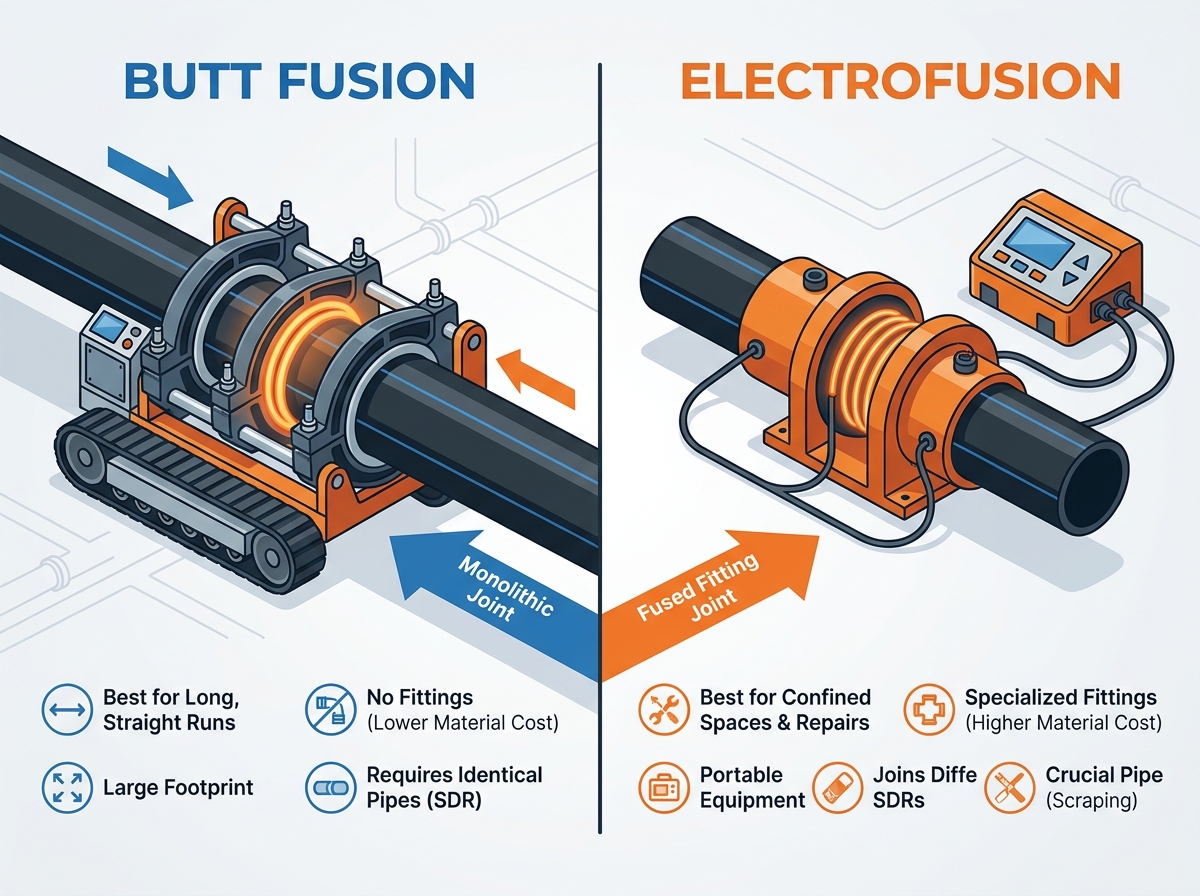
Using butt fusion HDPE pipe technology remains the standard for large-scale infrastructure. This method joins two pipe ends directly together without additional couplers. It relies heavily on specialized mechanical equipment to manage alignment and force.
The mechanics of this technique follow a strict chronological sequence. Operators must execute each phase without interruption.
Facing: Operators place the pipe ends into a specialized machine. A rotating planer shaves the ends to ensure they are perfectly parallel and clean.
Heating: A PTFE-coated heating plate drops between the two ends. The machine pushes the pipes against the plate at a specific pressure to melt the material evenly.
Joining: The operator removes the heating plate quickly. They then push the molten pipe ends together under controlled hydraulic pressure.
Cooling: The joint remains clamped under pressure while it cools. This forms a distinct, dual melt bead around the circumference.
This approach offers incredible economic advantages for massive projects. First, it requires no additional fittings. This significantly lowers the per-joint material cost. Second, it delivers highly consistent results. Inspectors can verify joint quality easily through visual bead inspection. Finally, it proves exceptionally efficient for long-distance, high-volume installations. Municipal water mains, extensive agricultural irrigation, and mining slurry lines rely heavily on this efficiency.
However, this technique carries severe spatial limitations. It requires a massive footprint for the fusion machine and support vehicles. Furthermore, the pipes must be identically sized with matching standard dimension ratios (SDR). Mismatched wall thicknesses prevent proper mating. Finally, it proves nearly impossible to execute inside a narrow, deep trench.
When massive machines cannot fit into your workspace, electrofusion HDPE pipe methods provide the perfect solution. This technique approaches molecular bonding from a completely different angle. It relies on internal heat generation rather than external heating plates.
This process uses specialized couplings, saddles, or tees. These fittings contain embedded electrical heating coils just beneath their inner surface. The operator inserts the prepared pipe ends into the fitting. They then connect a computerized processor to the fitting's external terminal pins. The processor reads a barcode on the fitting. It automatically applies a precise electrical current for a specific duration. This current heats the coils, melting both the fitting and the pipe from the inside out. They expand and fuse together as a single unit.
This technique shines in challenging environments. It proves exceptional for tight spaces, vertical drops, and active trenches. The equipment requires very little physical space. Additionally, this method can join pipes of different SDRs or slightly different polymer grades. For example, you can safely connect new PE100 pipe to older PE80 pipe. This makes it ideal for emergency repairs, saddle branches, and final system tie-ins.
The primary drawback involves material expense. Electrofusion fittings cost significantly more than bare pipe ends. Moreover, the process remains hyper-sensitive to proper pipe preparation. Failure to peel or scrape the oxidation layer is the absolute leading cause of joint failure. You cannot rush the preparation phase.
Selecting the correct approach requires balancing economic realities against site constraints. You must look beyond simple material prices. The environment, project scale, and capital deployment all dictate the final choice.
You must compare equipment costs against consumable costs. Butt fusion machines carry a high capital expenditure for purchase or heavy daily rental fees. However, the per-joint cost is incredibly low. Conversely, electrofusion requires minimal equipment investment. You only need a lightweight control box. Yet, the high consumable cost of the specialized fittings drives up operational expenses rapidly on high-volume runs.
Space dictates your options immediately. A track-mounted fusion machine needs a large, flat staging area. You must drag the finished pipe strings into position afterward. The alternative provides immense portability. An operator can carry a control processor into a trench or up a scaffold, assembling the network in place.
Massive initial layouts favor large mechanical joining. You can weld miles of pipe quickly on flat terrain. Localized distribution networks favor couplers. When you add individual service connections, navigate tight city grids, or perform routine maintenance, localized melting makes much more sense.
Wind, dust, and moisture plague any field welding operation. Large mechanical joining offers a slight advantage here. The melting faces remain somewhat protected right up until joining. Coupler assembly exposes the scraped pipe to the environment longer. Contamination easily sneaks into the gap between the pipe and the fitting before the current activates. Both require shelter during active precipitation.
Comparison Factor | Butt Fusion | Electrofusion |
|---|---|---|
Material Cost (Per Joint) | Low (No extra fittings) | High (Requires specialized fitting) |
Equipment Footprint | Large (Requires heavy machinery) | Small (Requires portable processor) |
SDR Compatibility | Must match exactly | Can join mismatched thicknesses |
Ideal Application | Long, straight, above-ground runs | Tight trenches, repairs, tie-ins |
Preparation Sensitivity | Moderate (Facing tool handles most) | Extreme (Manual peeling mandatory) |
Theoretical knowledge means nothing without field discipline. Many perfectly designed systems fail due to poor execution. Successful HDPE pipe welding demands uncompromising attention to detail. Operator error causes nearly all recorded joint failures.
Thermoplastics degrade slightly when exposed to ultraviolet light and oxygen. This creates a microscopic oxidized layer on the pipe surface. You must remove this layer. Emphasize to your crew that skipping the mechanical scraping process guarantees an electrofusion failure. Chemical wipes only remove dirt. They do not remove the oxidized polymer. If you do not mechanically scrape the surface, the molten materials will not cross-link. The joint will eventually burst under pressure.
Contractors often try to rush cooling times to maintain aggressive schedules. This presents a massive structural risk. The polymer chains require adequate time to solidify under clamp pressure. If you move or stress a joint prematurely, you create microscopic fractures inside the bead. These unseen fractures propagate over time. Always adhere strictly to the manufacturer's cooling timetables. Do not unclamp early.
Strict alignment ensures uniform stress distribution. In direct joining, poor alignment creates "high-low" mismatch. The pipe walls do not line up perfectly. This creates severe stress concentrators that weaken the pipeline. In coupler joining, lack of proper clamping causes melt blowouts. The expanding molten plastic can push the pipe backward out of the fitting. Always secure the assembly with dedicated mechanical clamps.
Mistake: Using isopropyl alcohol to clean before scraping. Best Practice: Always scrape first, then clean to remove final dust particles.
Mistake: Using sandpaper or emery cloth for surface preparation. Best Practice: Use dedicated rotary peeling tools to ensure uniform material removal.
Mistake: Guessing heater plate temperatures. Best Practice: Use infrared pyrometers to verify plate temperature daily.
Modern equipment eliminates guesswork. Today's fusion machines feature advanced data logging capabilities. They track the exact temperature, pressure, and duration of every single weld. Project engineers should require contractors to submit these data logs for accountability. This digital paper trail proves that the crew followed standard operating procedures.
Specifying the correct method prevents costly rework. You must evaluate the site conditions objectively before purchasing materials. Rely on logical decision-making trees rather than personal preference.
Use this rapid decision matrix to guide your initial HDPE Pipe planning phase:
If you are laying 1,000 feet of straight pipe above ground: Specify Butt Fusion. The lower material costs and rapid succession speed make it the obvious choice.
If you are repairing a burst pipe in a muddy 3-foot trench: Specify Electrofusion. You cannot fit heavy equipment down there safely, and you likely need to connect different material grades.
If you are navigating an intricate facility with multiple directional changes: Use a hybrid approach. Weld long straight sections outside the facility, then use couplers to tie those strings together indoors.
Now that you understand the nuances of HDPE pipe joining, you must take specific actions. First, audit your job site access. Measure the width of your trenches and staging areas. Second, calculate the break-even point between fitting costs and heavy machine rental fees for your specific distance. Finally, demand proof of certification. Verify that your chosen contractor holds current qualifications for the exact method you specify.
Creating robust infrastructure requires careful planning and rigorous execution. Neither joining method proves universally superior in all scenarios. Their efficacy depends entirely on your project context, spatial accessibility, and operator discipline. Using large mechanical machinery saves immense capital on long runs, while specialized couplers rescue complex repairs and tight installations.
Ultimately, reliable HDPE pipelines are built on evidence-based method selection. They survive decades of stress through uncompromising field preparation. Protect your infrastructure investments by matching the correct technology to your site realities. Enforce strict adherence to cooling times and scraping procedures, and your pipeline will outlast the facilities it serves.
A: Yes, but strictly using electrofusion or mechanical fittings. Do not use butt fusion due to uneven wall mating. Different wall thicknesses create inconsistent melt beads under direct hydraulic pressure. Electrofusion couplings accommodate these internal variations seamlessly from the outside, ensuring a secure bond.
A: Moisture introduces steam directly into the melt zone. This creates dangerous voids and porosity inside the joint. Such microscopic defects compromise structural integrity entirely. You must perform all welding under a protective tent or shelter. If you cannot keep the environment completely dry, pause operations immediately.
A: You rely primarily on a visual inspection of the melt bead. Check its size, shape, and uniformity, looking for proper bead rollback. Supplement this visual check by reviewing digital data logger reports. For comprehensive validation, contractors often perform destructive testing on sample joints before starting.
A: Absolutely mandatory. Chemical wipes cannot remove the oxidized layer from the pipe surface. Only precise mechanical peeling ensures the necessary molecular cross-linking. Skipping this vital step is the leading cause of joint failure. Always use a dedicated mechanical scraping tool before attaching the fitting.


