
Views: 0 Author: Site Editor Publish Time: 2026-10-23 Origin: Site


Upgrading or installing municipal water networks demands careful planning and precise material selection. You must balance upfront material expenses against long-term hydraulic performance and lifecycle durability. Traditional materials often force engineers into difficult compromises. Iron pipes are heavy, prone to interior scaling, and highly vulnerable to external rust. Standard unplasticized PVC requires very thick walls to handle high municipal pressures, which ultimately reduces the internal flow space. These traditional tradeoffs complicate network design, increase transportation logistics, and inflate pumping energy demands.
Fortunately, a highly engineered solution exists. By fundamentally altering the polymer structure during manufacturing, biaxial orientation delivers remarkable results. It significantly increases tensile strength and impact resistance without adding heavy wall thickness. This technical guide provides engineers, contractors, and city planners with an evidence-based framework. We will evaluate PVC-O Pipe options, verify compliance standards, and determine if this specific material fits the unique hydraulic and structural demands of your infrastructure project.
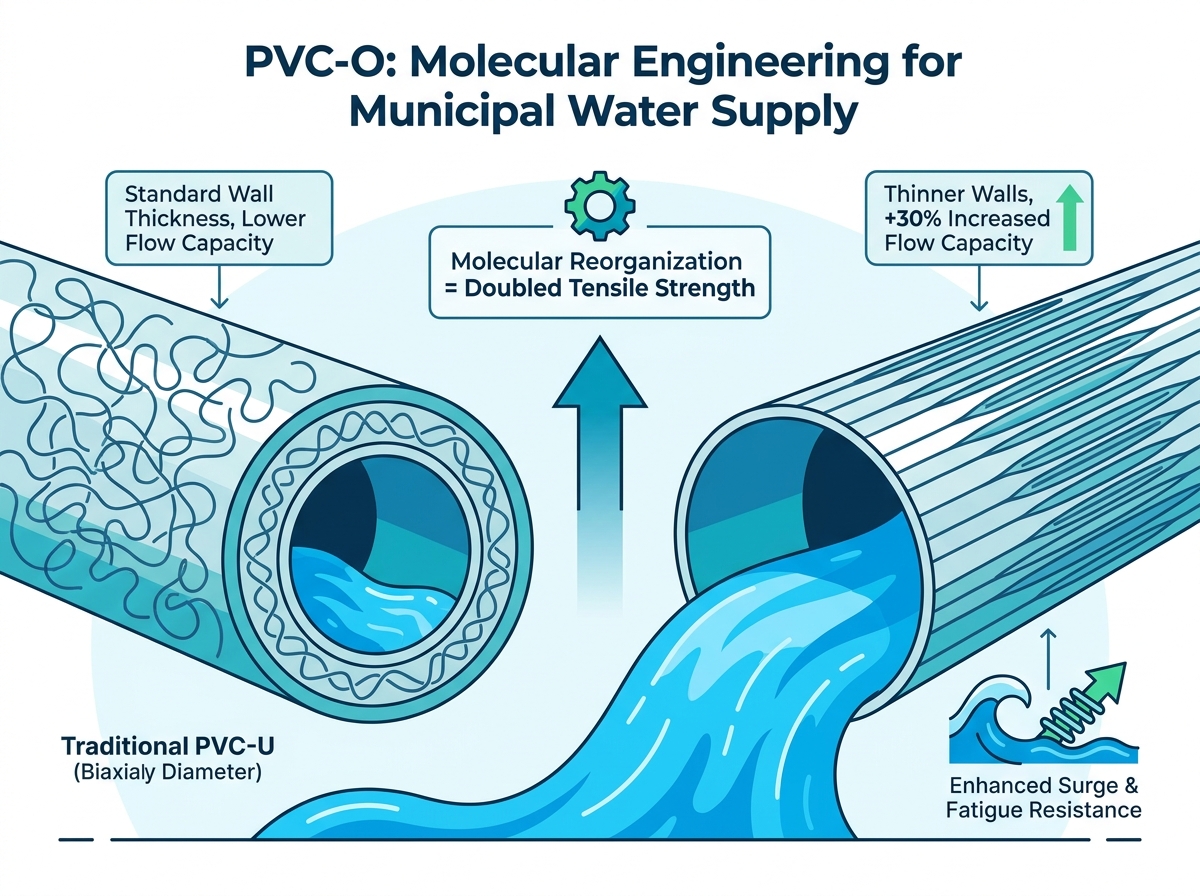
Structural Efficiency: Biaxial orientation doubles the tensile strength of traditional PVC, allowing for thinner walls and up to a 30% increase in flow capacity for municipal water supply pipes.
Pressure Resilience: PVC-O pressure pipe handles recurring surge pressures and water hammer events better than standard PVC due to its layered molecular structure.
Cost-to-Performance: While material costs may differ from standard PVC, savings are typically realized through faster installation (lighter weight) and lower pumping costs (increased internal diameter).
Standardization: Validating AWWA C909 or ISO 16422 compliance is non-negotiable for ensuring 50-to-100-year design life in municipal applications.
To understand the structural advantages of an oriented PVC pipe, you must look at its manufacturing process. Standard PVC possesses a random, amorphous molecular structure. It behaves predictably under stress but remains vulnerable to point-load cracking. Manufacturers change this by heating extruded PVC pipes under precise temperature controls and stretching them in both the hoop (radial) and axial (longitudinal) directions.
This dual-axis stretching reorganizes the polymer chains into a highly ordered, layered structure. The process eliminates micro-cracks inherent in standard extrusion. It essentially transforms a rigid plastic into an elastic, highly resilient matrix. If a point load strikes the pipe, the layered molecular structure stops cracks from propagating through the pipe wall.
Engineers classify plastic pipes by their Minimum Required Strength (MRS). Traditional PVC-U typically achieves an MRS of 250 (25 MPa). Biaxial orientation doubles this performance, allowing the material to achieve an MRS of 500 (50 MPa). This dramatic increase in material classification means you get twice the tensile strength from the exact same polymer formulation. It fundamentally alters the strength-to-weight ratio, allowing crews to handle larger diameter pipes without heavy lifting equipment.
Material Strength Comparison Chart
Material Type | Molecular Structure | Minimum Required Strength (MRS) | Relative Impact Resistance |
|---|---|---|---|
Standard PVC-U | Amorphous / Random | 250 (25 MPa) | Standard |
Biaxially Oriented PVC | Layered / Aligned | 500 (50 MPa) | Exceptionally High |
Enhanced hoop strength directly impacts pipe design geometry. Because the material tolerates higher stress, manufacturers can drastically reduce the wall thickness while maintaining identical or superior pressure capacities. A thinner wall means a larger internal diameter for the same nominal outside diameter.
This larger internal volume transforms fluid dynamics. Water experiences less friction, moving more efficiently through the system. Municipalities benefit from this increased cross-sectional area because pumps operate at lower pressures to deliver the same volume of water, conserving significant energy over decades of operation.
Selecting materials for critical infrastructure requires strict adherence to international and regional standards. A defined PVC-O pipe pressure rating guarantees the material will perform safely under maximum operational loads.
Engineers must verify regulatory compliance before specifying any product. Different regions utilize distinct certification bodies for a municipal water supply pipe:
AWWA C909: This standard dictates the manufacturing, testing, and performance criteria for molecularly oriented polymeric pressure pipe in North America. It covers nominal sizes from 4 inches through 36 inches.
ISO 16422: International projects rely on this standard. It specifies the requirements for pipes and joints made of oriented unplasticized poly(vinyl chloride) intended for the conveyance of water under pressure.
Manufacturers categorize pipes using Pressure Nominal (PN) or Pressure Class (PC) designations. These ratings inform you exactly how much internal pressure the pipe can safely sustain over a 50-year continuous lifecycle.
Metric PN Classes: You will commonly see PN16 (16 bar), PN20 (20 bar), and PN25 (25 bar) in ISO-compliant markets.
Imperial PC Classes: North American markets typically specify PC 150 (150 psi), PC 235 (235 psi), or PC 305 (305 psi).
These ratings include robust safety factors. Standards bodies build in safety margins typically ranging from 2.0 to 2.5. This means a pipe rated for 235 psi has a short-term burst pressure exceeding 500 psi. This generous safety margin protects the network against unexpected system over-pressurization.
Municipal water networks frequently experience cyclic loading. Pump starts, valve closures, and rapid demand shifts create water hammer—a pressure surge traveling rapidly through the fluid. Rigid legacy materials transfer this stress directly to the pipe joints and walls, leading to fatigue failure over time.
Oriented pipes feature a lower modulus of elasticity compared to metal or standard plastic. This elasticity absorbs the kinetic energy of a water hammer surge. The pipe wall flexes slightly, dampening the pressure wave celerity (speed) and significantly reducing the risk of point-stress failure during cyclic loading events.
When selecting a PVC-O water pipe for utility networks, you must evaluate its performance beyond simple burst pressure. Hydraulic efficiency, soil adaptability, and installation flexibility dictate whether the pipe will meet project goals.
Hydraulic capacity relies heavily on the internal surface smoothness. Engineers use the Hazen-Williams C-factor to calculate friction loss. Oriented pipes maintain a C-factor of 150 or higher throughout their lifespan. Unlike ductile iron, which experiences internal tuberculation and scaling that drops its C-factor to 100 or lower over time, plastic pipes remain consistently smooth.
Furthermore, because the orientation process reduces the wall thickness, the internal diameter increases. A larger internal diameter paired with a permanently smooth surface results in higher flow volumes. System operators can reduce pump energy consumption drastically, achieving the required flow rates at lower operating heads.
Hydraulic Efficiency Summary Chart
Pipe Material | Initial C-Factor | Long-Term C-Factor (50 Years) | Internal Scaling Risk |
|---|---|---|---|
Oriented PVC | 150+ | 150+ | None |
Standard PVC-U | 150 | 150 | None |
Cement-Lined Ductile Iron | 140 | 100 - 120 | Moderate |
Underground municipal networks face highly aggressive soil environments. Coastal regions present high salinity, while industrial areas often harbor acidic soils. Metallic pipes require extensive protective measures against these elements. You must install polyethylene wrap, epoxy coatings, or active cathodic protection systems to prevent galvanic corrosion.
Polymer materials eliminate this burden. They are entirely immune to galvanic and electrolytic corrosion. They will not rust, pit, or degrade when exposed to aggressive native soils. This immunity simplifies site preparation and ensures water quality remains uncontaminated by iron oxide or exterior soil pollutants over the decades.
The flexibility of the material significantly impacts excavation strategies. In standard open-cut trenches, the pipe's natural bend radius allows contractors to navigate sweeping curves without installing engineered elbows or thrust blocks. This reduces the number of joint connections, which are historically the weakest points in any pipeline.
For trenchless applications, particularly Horizontal Directional Drilling (HDD), engineers can utilize oriented pipes if they pair them with specialized restrained joint systems. The pipe's combination of high tensile strength and flexibility makes it highly adaptable to pulling forces, minimizing ground disturbance in congested urban corridors.
A successful pipeline deployment relies on proper field execution. While a PVC-O pressure pipe offers distinct advantages, construction crews must understand its specific handling and installation nuances to prevent implementation failures.
Logistical efficiency improves dramatically with lighter materials. Oriented pipe weighs up to 50% less than standard PVC and vastly less than ductile iron. A small construction crew can manually maneuver large-diameter sections into a trench without relying constantly on heavy excavators or cranes.
This weight reduction also improves shipping logistics. Trucks can carry more linear feet of pipe before hitting highway weight restrictions, reducing the number of deliveries required for a massive transmission main project.
Most installations utilize push-on elastomeric gasket joints. These joints provide a watertight seal and allow for minor thermal expansion and contraction within the trench.
Implementation Risk: You must strictly verify compatibility between the pipe and system fittings. Fittings, valves, and hydrants often utilize Mechanical Joints (MJ). You must ensure that the MJ glands, transition gaskets, and restraint rings are specifically rated for the Outside Diameter (OD) system you chose (e.g., Cast Iron Outside Diameter vs. Iron Pipe Size). Using unmatched fittings will lead to joint blowouts under pressure.
Municipal water networks require continuous tapping for residential service lines and air relief valves.
Common Mistake: Crews often attempt to direct-tap plastic pipes as they would an iron pipe. Direct threading requires a thick wall to provide enough thread engagement to hold the corporation stop. Because oriented pipes feature deliberately thinner walls, direct tapping poses a severe pull-out risk.
Best Practice: Always use heavily engineered service saddles for tapping. A service saddle wraps around the pipe, distributing the mechanical stress over a wide surface area and providing a secure, leak-proof threaded outlet for the service connection without compromising the host pipe's structural integrity.
No single material works perfectly for every scenario. Matching exact PVC-O pipe specifications to your site conditions ensures maximum network reliability.
Understanding ideal applications prevents specification errors. You should utilize specific decision frameworks before approving materials.
Ideal Use Cases: This material excels in long-distance transmission mains where reducing friction loss translates to massive energy savings. It is perfect for aggressive, highly corrosive soil environments, marshlands, and coastal zones. It also performs exceptionally well in pump station discharge lines that experience frequent surge pressures.
Sub-Optimal Use Cases: Avoid using this material for above-ground installations exposed to prolonged, direct ultraviolet (UV) sunlight unless you apply proper UV-resistant shielding or paints. It is also unsuitable for highly industrial applications conveying extreme high-temperature chemical fluids, as thermal limits apply to all thermoplastic materials.
Once you confirm the material suits your environment, follow a structured process to finalize the specification package:
Verify Flow Rates: Calculate the necessary flow volume and velocity. Use these numbers to determine the minimum internal diameter required, factoring in the improved C-factor.
Assess Pressure Demands: Cross-reference the system's maximum continuous operating pressure with anticipated surge pressures (water hammer). Select a PC or PN class that accommodates both, incorporating a minimum 2.0 safety factor.
Audit Local Codes: Review your municipality’s pre-approved materials list. Ensure the specific AWWA C909 or ISO 16422 certifications align with local utility compliance mandates.
Specify Joint Restraints: For areas requiring directional drilling or steep slopes, explicitly specify compatible mechanical joint restraints designed for the exact OD and thinner wall profile.
Upgrading municipal networks requires materials that guarantee both immediate installation efficiency and decades of uninterrupted service. Biaxially oriented pipe represents a highly efficient, value-engineered alternative to rigid traditional materials. By altering the polymer structure, manufacturers deliver superior hydraulics, unmatched fatigue resistance, and absolute immunity to soil corrosion.
Project engineers and utility planners should confidently prioritize this material where soil corrosivity, hydraulic efficiency, and long-term operating pressures dictate project success. Take action by reviewing your current pipeline specifications, calculating your required pressure classes against AWWA or ISO standards, and engaging with certified manufacturers to verify fitting compatibilities for your next infrastructure bid.
A: Schedule 40 and 80 refer strictly to wall thickness dimensions under the IPS sizing system, not specific performance capabilities. Oriented pipe uses specific pressure classes (PC or PN) based on enhanced material tensile strength. It achieves much higher pressure ratings while utilizing significantly thinner walls than both Schedule 40 and 80 pipes.
A: You can use standard fittings only if the outside diameter (OD) systems match perfectly. You must verify whether your pipe follows Cast Iron Outside Diameter (CIOD) or Iron Pipe Size (IPS). Furthermore, the fitting's pressure rating must meet or exceed the pressure class of the host pipe to prevent system failure.
A: Industry projections indicate a design life expectancy of 50 to 100+ years. This lifespan assumes the contractor followed correct installation practices, utilized proper trench bedding and backfill, and ensured the system operates strictly within the manufacturer's specified pressure class limits and surge tolerances.
A: Yes, it is suitable for trenchless installations like horizontal directional drilling (HDD). However, success depends entirely on using specialized restrained joint systems to prevent joint separation. You must also strictly adhere to the manufacturer's maximum allowable pull-force ratings and bend radius limits during the pulling process.


