
Views: 0 Author: Site Editor Publish Time: 2026-10-17 Origin: Site


Specifying the wrong material for a high-pressure municipal, industrial, or mining project carries severe consequences. Under-specifying risks catastrophic burst failures and major compliance breaches. Conversely, over-specifying inflates material costs and unnecessarily restricts internal flow capacity. Engineers face a unique challenge here. You must navigate the inverse relationship between SDR (Standard Dimension Ratio) and pressure capacity. You also need to factor in environmental variables like temperature fluctuations and severe installation stress.
A minor miscalculation often leads to disastrous system failures or massive budget overruns. This guide equips engineers, procurement teams, and contractors with a definitive evaluation framework. We will help you calculate precise wall thickness requirements and navigate complex environmental variables. By the end, you can confidently shortlist the correct HDPE Pipe specifications for your infrastructure projects.
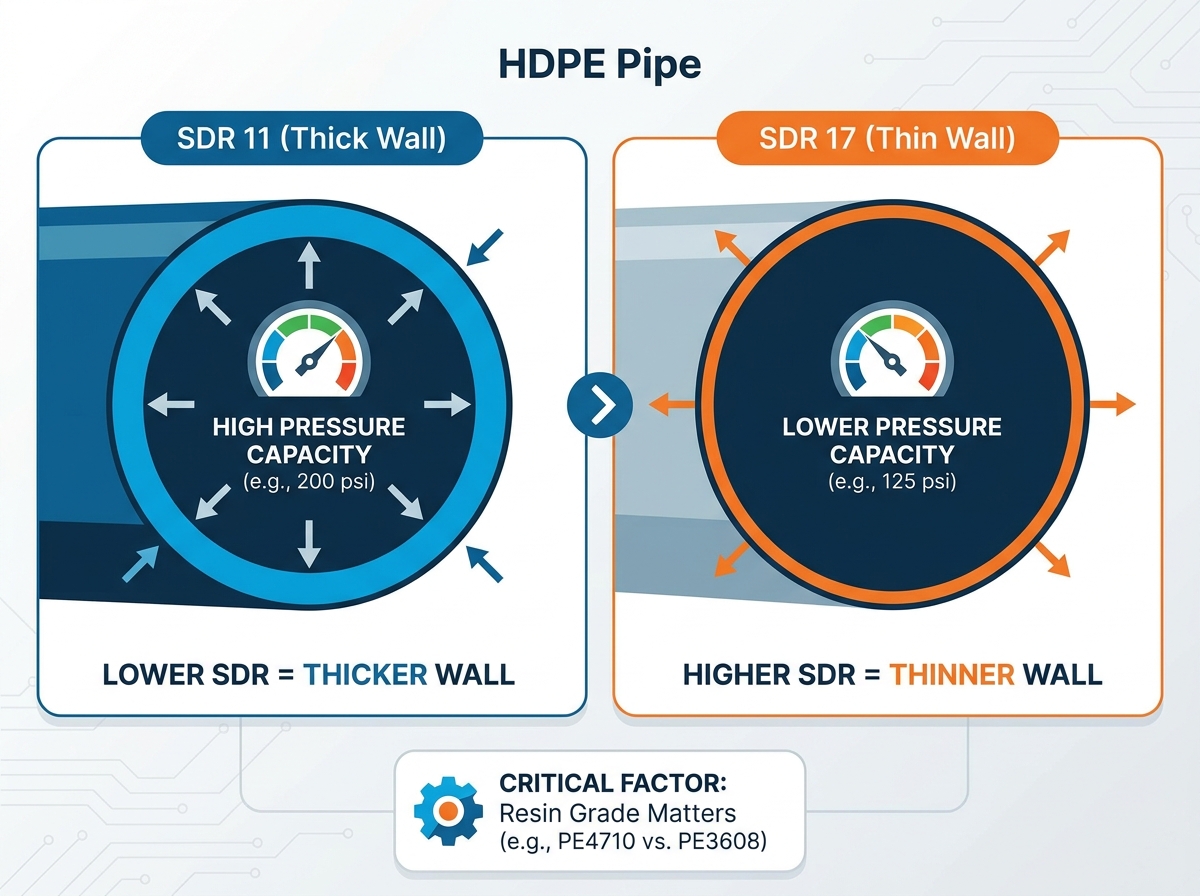
SDR is a ratio, not a rigid measurement: It represents the pipe's outside diameter divided by its minimum wall thickness. A lower SDR means a thicker wall and higher pressure capacity.
Resin matters as much as thickness: An SDR rating only translates to a true HDPE pipe pressure rating when paired with a specific resin grade (e.g., PE4710 vs. PE3608).
Installation methods dictate baseline SDR: Trenchless installations like Horizontal Directional Drilling (HDD) often require lower SDRs (thicker walls) to withstand tensile pull-stresses, regardless of operating fluid pressure.
Flow vs. Strength trade-off: Thicker walls reduce the pipe's internal diameter (ID), impacting flow rates and requiring hydraulic recalculations.
Understanding SDR requires looking at the fundamental geometry of polymer piping. Standard Dimension Ratio describes a precise proportional relationship. It correlates the physical bulk of the pipe to its overall size.
The industry uses a universal formula to determine this ratio. You calculate SDR by dividing the nominal Outside Diameter (OD) by the Minimum Wall Thickness (t).
SDR = Outside Diameter ÷ Minimum Wall Thickness
Outside Diameter (OD) = The total distance across the pipe cross-section.
Minimum Wall Thickness (t) = The thinnest allowable boundary of the pipe wall.
If you have an outside diameter of 10.75 inches and a minimum wall thickness of 0.977 inches, the math is simple. Divide 10.75 by 0.977. You get an SDR of 11.
Many new engineers find the SDR scale slightly counterintuitive initially. You must remember one golden rule. Lower SDR numbers equal thicker walls. An SDR 9 pipe features a heavily reinforced, thick wall. It handles extreme pressure seamlessly. An SDR 21 pipe features a much thinner wall. It serves best in low-pressure gravity systems. A smaller ratio means the wall thickness represents a larger fraction of the total diameter.
Engineers rely on SDR because it standardizes performance. It maintains a consistent pressure rating across all pipe diameters. Think about designing a massive municipal water network. You might use 4-inch lines for local distribution and 24-inch mains for primary transmission. If both lines use identical resin and share an SDR 11 rating, they boast the exact same pressure capacity.
This proportional scaling simplifies complex HDPE pipe specifications across sprawling networks. You do not need to memorize unique thickness charts for every individual pipe diameter. You simply specify the required SDR and resin combination. The manufacturer scales the physical dimensions accordingly.
You cannot determine system capacity using SDR alone. The underlying polymer chemistry plays a massive role. Environmental conditions also dramatically alter baseline performance.
Modern pipe manufacturing relies heavily on advanced polymer formulations. The industry recently transitioned from older PE3608 resins to high-performance PE4710 grades. This shift completely transformed standard capacity charts. PE4710 features higher density and superior slow crack growth resistance. It allows engineers to push more pressure through thinner walls safely.
For example, a standard SDR 11 pipe extruded from PE3608 historically offered a 160 psi rating. Today, an identical SDR 11 pipe extruded from PE4710 achieves a robust 200 psi rating. Upgrading the resin often eliminates the need for thicker, heavier pipes.
Hydraulic systems rarely operate under perfect, static conditions. Fluid velocity changes create dynamic pressure spikes. You must evaluate two distinct surge profiles.
Occasional Surge: Sudden valve closures cause brief pressure spikes. High-density polyethylene absorbs these transient shocks exceptionally well. The material expands slightly to dissipate energy. Typical systems safely handle occasional surges up to 200% of their base WPR.
Recurring Surge: Some systems experience constant hydraulic fatigue. Rapid pump cycling creates frequent water hammer events. You must proactively derate the base working pressure for these environments. Frequent stress accelerates material fatigue and shortens operational lifespan.
Heat degrades polymer strength predictably. Manufacturers establish all standard pressure ratings at a baseline temperature of 73.4°F (23°C). Operating your system above 80°F mandates a rigid safety multiplier. This multiplier reduces the effective pressure capacity.
If you pump 100°F industrial effluent through a 200 psi rated line, the pipe no longer safely holds 200 psi. You must apply the corresponding thermal derating factor to prevent catastrophic ballooning or ruptures.
Operating Temperature (°F) | Operating Temperature (°C) | PE4710 Derating Multiplier |
|---|---|---|
73.4°F | 23°C | 1.00 (Base Rating) |
100°F | 38°C | 0.78 |
120°F | 49°C | 0.63 |
140°F | 60°C | 0.50 |
Engineers usually narrow their selection down to two dominant specifications. Understanding the specific trade-offs between them prevents costly installation errors.
The SDR11 HDPE pipe serves as the undisputed heavyweight champion for extreme environments. Extruded from PE4710, it delivers a formidable 200 psi pressure rating. It handles intense mechanical stress effortlessly.
Primary Applications: High-pressure municipal water mains, forced sewer mains, rugged mining slurries, and demanding HDD installations.
Key Trade-offs: The thick wall adds significant material weight per foot. This increases shipping costs and complicates onsite handling. More importantly, it shrinks the internal diameter. You must recalculate pump sizing to accommodate reduced internal flow capacity.
The SDR17 HDPE pipe dominates standard-duty applications. It offers an optimal balance of structural integrity and fluid dynamics. Extruded from PE4710, it safely sustains a 125 psi working pressure.
Primary Applications: Gravity flow sewers, low-pressure agricultural irrigation, open-trench installations, and landfill gas extraction networks.
Key Trade-offs: It delivers superior flow capacity and dramatically lowers initial material costs. However, it remains highly susceptible to physical deformation. Heavy external loads or sudden vacuum pressures easily crush or oval the thinner walls.
Choosing between these two options requires a systematic heuristic approach. First, evaluate your total dynamic head (TDH). If system pressure exceeds 125 psi, SDR 17 immediately drops out of contention. Next, evaluate the installation method. Trenchless pulls usually demand SDR 11 to prevent stretching. Finally, consider budget constraints. If an open trench gravity line only requires minimal pressure capacity, specifying SDR 11 wastes significant capital.
Feature | SDR 11 (PE4710) | SDR 17 (PE4710) |
|---|---|---|
Pressure Rating | 200 psi | 125 psi |
Wall Thickness | Thicker | Thinner |
Internal Diameter | Reduced | Maximized |
Material Weight | Heavy | Lighter |
Best Installation | HDD / Deep Burial | Open Trench / Shallow |
Many system failures occur because engineers only calculate internal fluid pressure. Real-world environments introduce severe external forces. These hidden stressors frequently dictate a lower HDPE pipe SDR than the fluid dynamics strictly require.
Trenchless installation completely changes the engineering math. Horizontal Directional Drilling (HDD) subjects the pipeline to extreme tensile forces. Heavy rigs drag long strings of fused pipe through abrasive underground boreholes. This creates massive pull-force friction.
If you specify a high SDR (thin wall) for an HDD project, the rig might stretch the pipe beyond its yield point. Yielding compromises structural integrity and drastically shortens system life. Engineers routinely specify heavy-wall SDR 11 for HDD pulls, even if the internal fluid pressure only requires SDR 17. The installation stress overrules the fluid pressure.
Burial conditions exert constant downward pressure on underground infrastructure. You must evaluate soil weight and surface activity carefully. Deep burial depths generate immense static soil loads. High groundwater tables add hydrostatic crushing forces. Live traffic loads (H-20 highway ratings) send dynamic vibrations deep into the trench.
These combined external loads cause thin-walled pipes to oval or collapse completely. This happens frequently in gravity-flow applications featuring zero internal pressure. You must increase the wall thickness to provide necessary ring stiffness. A lower SDR resists radial deflection and maintains a perfect circular profile under heavy dirt cover.
Negative pressure presents a unique and dangerous risk profile. Pump suction lines occasionally experience sudden fluid voids. Rapid elevation changes in transmission networks also generate vacuum pockets during shutdown sequences. High-density polyethylene boasts incredible outward pressure resistance, but it struggles against inward vacuum forces. Sudden negative pressure easily collapses thin-walled pipes. You must deploy lower SDR specifications to combat potential vacuum conditions effectively.
Moving from the drawing board to procurement requires rigorous vendor vetting. You must ensure physical products match your theoretical calculations flawlessly.
Never rely solely on marketing brochures. Insist on strict regulatory compliance. Ensure shortlisted manufacturers rigorously adhere to AWWA C906 standards for municipal water applications. For industrial or general fluid transport, verify ASTM F714 compliance. These standards guarantee the manufacturer followed strict extrusion and quality control protocols. They provide an authoritative baseline for structural integrity.
Engineering math relies on minimums, but manufacturing realities introduce variances. When standards define HDPE pipe wall thickness, they refer to the absolute minimum allowable boundary. Extrusion processes aren't perfectly uniform. To avoid falling below the minimum, manufacturers typically build the wall slightly thicker.
Industry tolerances usually allow the wall to be up to 12% thicker than the stated minimum. Because the outside diameter remains strictly fixed, this extra thickness grows inward. It reduces the internal diameter slightly more than your base formula predicts. You must evaluate how this +12% variance impacts critical internal flow modeling and velocity calculations.
Not all extrusion facilities deliver equal quality. Vet your manufacturing partners using three critical criteria.
Access to Virgin Resin: Demand certifications proving the use of PE4710 virgin resin. Avoid vendors utilizing regrind materials for high-pressure infrastructure. Regrind introduces microscopic inconsistencies that weaken the structural matrix.
Technical Submittals: Request comprehensive engineering submittals before issuing purchase orders. Review their specific surge allowance charts and temperature derating tables. Ensure their math aligns with your project models.
Logistics and Lead Times: Standard sizes (like SDR 11 and SDR 17) usually sit in inventory. Custom SDR runs (like SDR 9 or SDR 13.5) require dedicated manufacturing shifts. Clarify lead times immediately to prevent construction delays.
Do not finalize a purchase order in isolation. We encourage buyers to share comprehensive hydraulic models and trench installation plans with a technical sales engineer. Let them review your math. A second technical review often catches subtle tolerance mismatches before the materials reach the job site.
Specifying high-density polyethylene pipelines requires careful balancing. You must weigh internal pressure demands against external environmental stressors and harsh installation methodologies. Focusing solely on internal fluid dynamics leaves your infrastructure vulnerable to crushing loads and tensile yielding.
We strongly recommend relying on established formulas and recognized environmental derating charts rather than generic field assumptions. Always design your system for the most extreme operating condition. Account for recurring water hammer surges, peak summer temperatures, and maximum HDD pull-stresses. Do not base your procurement solely on standard baseline working pressures.
Take action today to secure your infrastructure. Consult with a dedicated pipe specialist to review your hydraulic variables. Request a comprehensive technical submittal from your preferred manufacturer. Download a verified SDR sizing calculator to double-check your wall thickness math and confidently finalize your project specifications.
A: Divide the actual outside diameter (OD) by the SDR value. For example, if you have a 12.75-inch OD pipe rated at SDR 11, you divide 12.75 by 11. This calculation yields a minimum wall thickness of 1.159 inches.
A: Yes. The pressure rating depends heavily on the specific resin used. A pipe extruded from modern PE4710 resin yields a significantly higher pressure rating than older PE3608 resin at the exact same SDR. Operating temperature also changes the final rating.
A: Not always. While a lower SDR provides greater crush resistance and higher pressure capacity, it unnecessarily restricts fluid flow. It also increases material weight and project costs. You should avoid it if the environment does not require extreme structural integrity.
A: No. In standard IPS (Iron Pipe Size) and DIPS (Ductile Iron Pipe Size) systems, the outside diameter remains strictly constant. This ensures compatibility with standard fittings and fusion equipment. Changes in SDR only alter the inside diameter because the wall thickness grows inward.


