
Views: 0 Author: Site Editor Publish Time: 2026-08-01 Origin: Site


Selecting the right materials goes far beyond checking a basic diameter measurement. Mismatched schedules, incorrect resin grades, or non-compliant manufacturing quickly cause system failures. You risk severe code violations and expensive downtime when you choose the wrong specifications. Industrial operators and plumbing contractors face intense pressure to get these choices right every time.
Whether you source materials for municipal plumbing, industrial chemical handling, or commercial irrigation, precision matters immensely. Strict vendor evaluations remain critical to your project success. You must evaluate both product capabilities and vendor reliability before placing bulk orders.
This guide breaks down exact sizing parameters, application-specific requirements, and essential technical criteria. We give you the tools necessary to confidently select products for any application. You will learn how to vet a reliable supply chain and avoid common installation pitfalls.
Size Reality: "Nominal" size does not equal actual Outside Diameter (OD). Sizing confusion is the leading cause of pipe-to-fitting mismatch.
Schedule Dictates Application: Schedule 40 (white) and Schedule 80 (gray) share the same OD but have different interior diameters (ID) and pressure ratings.
Compliance is Mandatory: Potable water and pressure applications require specific ASTM and NSF certifications printed directly on the pipe.
Sourcing Strategy: Evaluating a vendor requires looking past unit price to assess resin consistency, factory extrusion capabilities, and freight logistics.
Specifying an under-rated material creates significant business risk. If you install a low-pressure pipe in a high-pressure commercial system, you risk catastrophic blowouts. Conversely, over-engineering a simple drainage system destroys project profit margins. You must match the material grade directly to the operational demands.
Industry standards divide common polyvinyl chloride pipes into two primary schedules. These categories define the wall thickness and maximum pressure capacity.
Schedule 40 (Standard Wall): This material typically features a white color. It works optimally for DWV (Drain, Waste, Vent) systems, residential irrigation, and low-pressure cold water distribution. It provides excellent flow volume but cannot handle severe industrial pressure.
Schedule 80 (Heavy Wall): This material generally features a gray color. Engineers design it specifically for industrial applications, chemical processing facilities, and high-pressure commercial environments. The thicker walls restrict interior flow slightly but offer superior burst strength.
Standard materials cannot handle high temperatures or extreme physical impacts. Specialty classifications solve these complex engineering challenges.
CPVC (Chlorinated PVC): Standard polyvinyl chloride degrades quickly under heat. CPVC handles much higher temperatures, operating safely up to 200°F (93°C). Building codes strictly require CPVC for commercial hot water distribution lines.
PVC-U, PVC-M, and PVC-O: Unplasticized (PVC-U) offers maximum rigidity for general construction. Modified (PVC-M) adds impact modifiers to prevent cracking under physical stress. Oriented (PVC-O) alters the molecular structure to provide massive burst strength for specialized municipal infrastructure projects.
Mixing DWV non-pressure pipes in pressurized applications creates an immediate implementation risk. DWV materials lack the structural integrity for continuous static pressure. Plumbers who mistakenly use DWV pipes for pressurized water supply lines inevitably face structural ruptures and severe flooding.
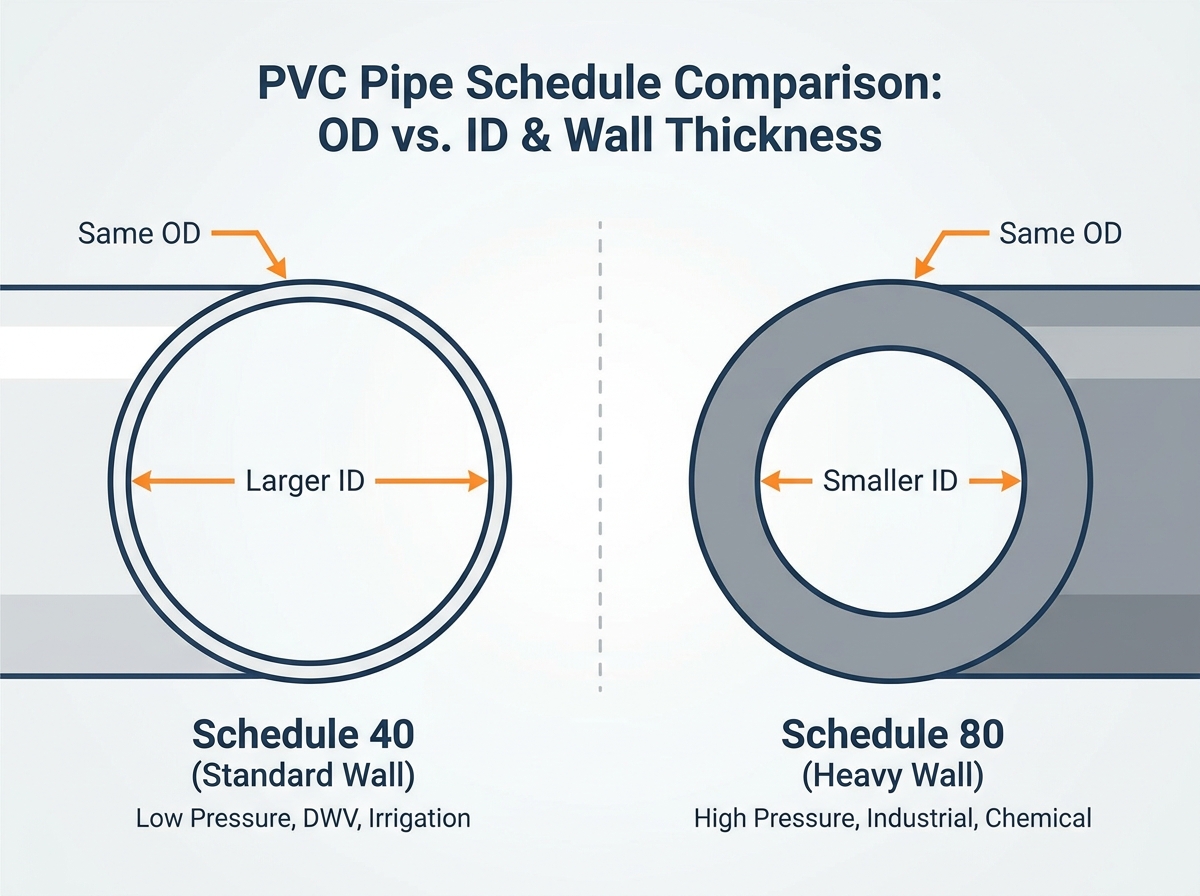
Navigating exact dimensions causes immense frustration for new procurement teams. Understanding PVC pipe sizes requires learning the difference between industry terminology and physical measurements. Failing to grasp this distinction leads to incompatible fittings and wasted materials.
Nominal Pipe Size (NPS) serves merely as a naming convention, not an exact measurement. For example, a 2-inch nominal pipe does not measure exactly 2 inches across the Outside Diameter (OD). The physical OD actually measures 2.375 inches.
The Outside Diameter remains completely constant across different schedules. This consistency ensures all fittings match regardless of wall thickness. However, the Inside Diameter (ID) shrinks as the wall thickness increases. A Schedule 80 pipe holds a smaller volume of fluid than a Schedule 40 pipe of the same nominal size.
The following chart illustrates the dimensional variance for common NPS ranges from 1/2-inch to 2-inch sizes. Technical buyers use these metrics to calculate precise flow rates.
Common NPS Measurement Reference
Nominal Pipe Size (NPS) | Outside Diameter (OD) | Schedule 40 Inside Diameter (ID) | Schedule 80 Inside Diameter (ID) |
|---|---|---|---|
1/2" | 0.840" | 0.622" | 0.546" |
3/4" | 1.050" | 0.824" | 0.742" |
1" | 1.315" | 1.049" | 0.957" |
1.5" | 1.900" | 1.610" | 1.500" |
2" | 2.375" | 2.067" | 1.939" |
Carefully reviewing PVC pipe specifications directly from the factory print line prevents severe compliance failures. Every certified product features a continuous spray code along its exterior.
You must look for mandatory markers to verify product quality. The print line should display the manufacturer name, the material designation code (such as PVC 1120), and the NPS. It also lists the Schedule or SDR rating alongside the specific pressure rating at 73°F. Finally, always verify the laboratory seal. An NSF-pw stamp guarantees safety for potable water applications.
Purchasing the correct materials solves only half the problem. Installation logistics govern the overall longevity of your fluid handling system. You must properly match connectors and apply the correct chemical welding procedures.
As a strict rule of thumb, you should match the schedule of the pipe directly to the schedule of the fitting. While you can physically insert a Schedule 40 fitting onto a Schedule 80 pipe, doing so compromises the entire system. The lower-rated fitting becomes an immediate weak point, restricting your maximum system pressure to Schedule 40 limits.
Contractors choose between slip (socket) and threaded connections based on system permanence. Slip connections provide a permanent, leak-proof seal ideal for high-pressure fluid transfer. Threaded connections allow for future disassembly, making them perfect for pump maintenance sections or temporary irrigation manifolds.
Chemical bonding requires exact environmental control and proper product selection. Solvent welding melts the plastic surfaces and fuses them together into one continuous piece of material.
You must select primer and cement based on the diameter and environment. Small residential systems safely use medium-bodied cement. Industrial applications utilizing pipes over 6 inches require heavy-bodied or extra-heavy-bodied cements. These thicker cements fill larger gaps and prevent joint separation under high stress.
Environmental factors degrade synthetic materials over time. Direct sunlight introduces massive UV degradation. The material becomes brittle, loses its impact resistance, and eventually shatters. You must protect exterior installations by insulating them, painting them with water-based latex, or formulating the order with factory UV inhibitors.
Thermal expansion poses another significant challenge. Synthetic pipes expand and contract dramatically during extreme temperature shifts. Long outdoor runs or industrial chemical lines require engineered expansion joints. These loops absorb linear movement and prevent fittings from snapping under tension.
Procuring reliable inventory requires investigating the production source. Quality control varies wildly across global supply chains. You must evaluate resin consistency and factory certifications before committing to bulk purchases.
A reputable PVC pipe manufacturer uses virgin, unadulterated resin. Some low-cost producers blend excess regrind into their extrusion process to save money. This practice creates brittle walls, inconsistent thicknesses, and structural weak points.
You should request technical documents proving strict adherence to ASTM standards. Demand compliance with ASTM D1785 for Schedule 40, 80, and 120 pressurized systems. If you specify drainage systems, verify adherence to ASTM D2665 for DWV applications.
Public health regulations require stringent testing protocols. You must verify NSF-61 certification for any pvc pipe used in potable water systems. The NSF-61 seal guarantees the material leaches zero toxic chemicals into the drinking supply.
Furthermore, you should look for ISO 9001 certification. This specific credential ensures strict quality control consistency at the PVC pipe factory. ISO-certified facilities monitor exact extrusion temperatures and conduct regular burst-testing on the assembly line.
Vendor capabilities extend beyond physical product quality. You must evaluate their inventory depth, custom length capabilities, and average lead times. Delays in raw material procurement will quickly paralyze your construction timeline.
Determine if the PVC pipe supplier handles complex freight classifications effectively. Bulk shipments require Less Than Truckload (LTL) or Full Truckload (FTL) logistics. Poorly packaged pallets result in severely damaged inventory upon arrival. Ask potential vendors about their historical freight damage rates and their exact replacement policies.
Creating a streamlined procurement strategy prevents severe delays and eliminates guesswork. Buyers need a standardized approach to narrow down supply partners quickly. Follow this proven shortlisting logic before releasing your purchase orders.
Define exact operational constraints: Document the system pressure limits, maximum expected temperatures, and specific fluid types. Chemical resistance varies drastically between standard and specialized resin formulas.
Select appropriate physical dimensions: Cross-reference the engineering blueprints to identify the required Schedule or SDR rating. Map out all necessary nominal sizes to ensure complete fitting compatibility.
Audit supplier compliance: Request proof of active ASTM and NSF credentials. Reject any vendor failing to provide current laboratory testing certificates for pressure applications.
Request physical samples: Ask for material spec sheets and short sample cut-sheets. Inspect the spray codes for clarity and verify the wall thickness consistency manually using specialized calipers before authorizing massive bulk deliveries.
Sourcing the correct materials demands extreme attention to technical details. You must constantly match your application demands, including pressure, temperature, and fluid type, against precise sizing standards. Never assume nominal sizes equal physical reality. Always verify the manufacturer specifications directly on the factory print line to ensure strict code compliance.
We highly recommend prioritizing vendors who maintain total transparency. Work exclusively with partners who provide clear print-line data and hold all necessary ASTM and NSF certifications. Solid vendor relationships offer robust technical support, simplify your bulk procurement logistics, and guarantee long-term system reliability.
A: Schedule uses standard wall thicknesses that vary depending on diameter. SDR (Standard Dimension Ratio) maintains a constant ratio between the pipe diameter and its wall thickness. This consistent ratio ensures SDR pipes deliver uniform pressure ratings across all sizes, whereas Schedule pressure ratings decrease as the diameter increases.
A: Technically, they fit perfectly due to identical Outside Diameters. However, doing so immediately compromises the pressure rating of your entire system. The weaker Schedule 40 fittings limit your maximum operational capacity, rendering the thicker Schedule 80 walls useless against pressure spikes.
A: Measure the Outside Diameter carefully using digital calipers. Once you have the exact physical measurement, convert it using an industry-standard NPS chart. Never rely on a standard tape measure stretched directly across the hole, as this usually results in inaccurate nominal sizing.
A: Usually, but not always. DWV pipe also typically features a white exterior but utilizes a thinner wall. DWV cannot hold static pressure safely. Always verify the factory print line to confirm the exact schedule and pressure rating before installation.


