
Views: 0 Author: Site Editor Publish Time: 2026-07-27 Origin: Site


You should pick the right pipe for your project. Think about temperature, chemicals, and how much money you have. PVC pipe is used most for low-pressure water and drains. In 2024, it has over 80% of the market. CPVC is better for hot and cold water. It can handle heat up to 200°F. PVC can only handle up to 140°F. CPVC and PVC are different in how strong they are. They are also different in how they are used in sanitation, HVAC, or farming.
CPVC pipe is good for hot water and strong chemicals. It can handle heat up to 200°F. PVC pipe costs less and is good for cold water and drains. Many people use it in homes. Think about what your project needs before you pick a pipe. You should also think about your budget and the weather. Always look for NSF/ANSI certification on pipes. This makes sure the pipes are safe for drinking water. Use the right tools when you put in the pipes. Follow safety steps to stop leaks and make the pipes last longer.
You should know how each pipe deals with heat and chemicals before picking one. CPVC can handle hotter water than PVC pipe. It works with water up to 200°F. PVC pipe can only go up to 140°F. This means CPVC is better for hot water and high heat jobs.
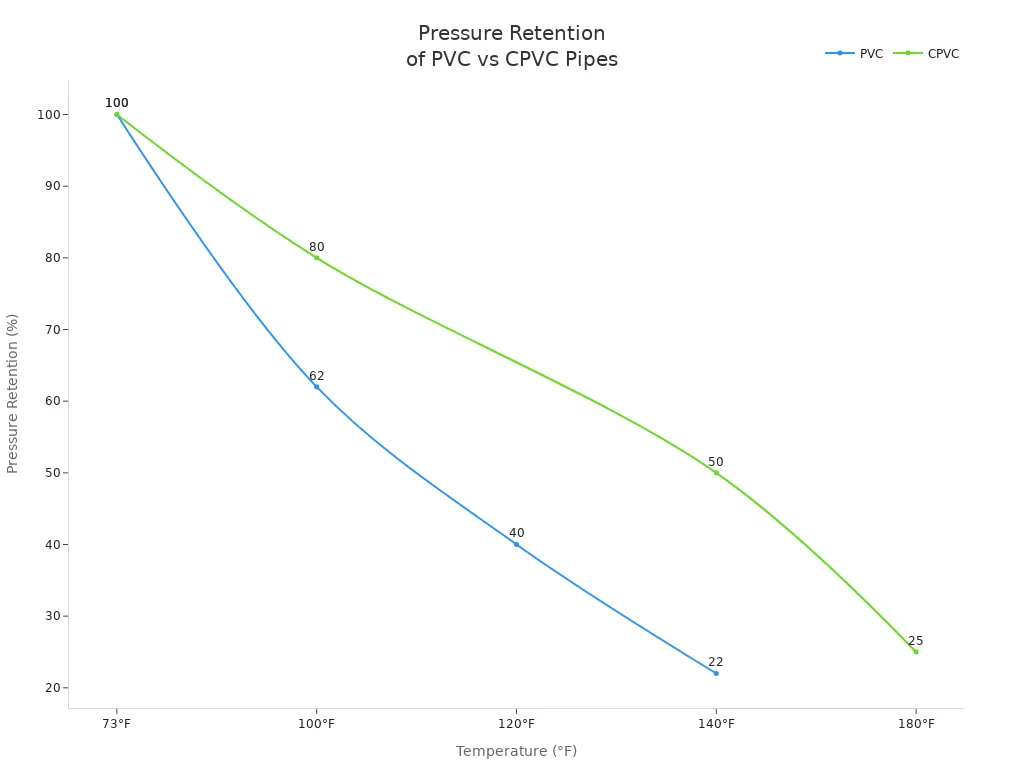
The table below shows how strong each pipe stays at different temperatures:
Temperature (°F) | PVC Pressure Retention (%) | CPVC Pressure Retention (%) |
|---|---|---|
73 | 100 | 100 |
100 | 62 | 80 |
120 | 40 | N/A |
140 | 22 | 50 |
180 | N/A | 25 |
200 | N/A | Max Continuous Service Temp 200°F |
CPVC also stands out because it fights off chemicals better. It has more chlorine in it. This makes it safe for drinking water and for strong acids and bases. You can use CPVC for clean water and where pipes touch harsh chemicals. PVC pipe is good for watering lawns and cold water, but it does not do well with strong chemicals like CPVC.
Tip: If you need pipes for hot water or strong chemicals, CPVC is safer.
You should also think about price and what each pipe is made from. CPVC costs more than PVC pipe. PVC pipe costs between $0.50 and $4.50 for each foot. CPVC costs between $1.00 and $5.00 for each foot. The higher price comes from the extra chlorine in CPVC. This gives it better heat and chemical resistance.
Pipe Type | Cost per Linear Foot |
|---|---|
PVC | $0.50 – $4.50 |
CPVC | $1.00 – $5.00 |
The way they are made is different too. PVC pipe uses polyvinyl chloride resin. CPVC starts as PVC but gets more chlorine added. This raises the chlorine from about 57% to as much as 69%. The extra chlorine helps CPVC handle hotter water and more chemicals.
Property | CPVC | PVC |
|---|---|---|
Temperature Capability | Up to 200° Fahrenheit | Peaks at 140° Fahrenheit |
Chemical Composition | Further chlorination of PVC | Polyvinyl chloride resin only |
ASTM Specification for Cements | ASTM F493 | ASTM D2564 |
Note: Both pipes last a long time. PVC pipe can last 70 to 100 years. CPVC usually lasts 50 to 75 years. Both types can be recycled, but CPVC is harder to recycle.
When you look at both, you see CPVC gives you better heat and chemical resistance. PVC pipe costs less and works well for cold water and watering plants. Pick the one that fits your project and budget.
PVC pipe is found in almost every house. It helps move waste and water away from your home. Plumbers like pvc pipe for drain-waste-vent systems. This is because it does not rust and lasts a long time. The table below shows how often pvc pipe is used:
Pipe Type | Application Type | Common Usage in Residential |
|---|---|---|
PVC | Drain-Waste-Vent (DWV) | Yes |
PEX | Supply Lines | Yes |
Copper | Supply Lines | Yes |
There are different kinds of pvc pipe for drains and underground work. Schedule 40 pvc pipe is good for drains and wastewater. Perforated pvc pipe is used for subsurface drainage, like French drains. These drains help keep your yard dry after rain.
Type of PVC Pipe | Application in Residential Construction |
|---|---|
Schedule 40 PVC | Used for drains and wastewater systems. |
Schedule 40 PVC | Good for underground drainage jobs. |
Perforated PVC | Used for subsurface drainage like French drains. |
If you want to water your yard, pvc pipe is a good choice. It can handle water pressure and does not rust. This helps your garden stay green all year.
Tip: Use Schedule 40 pvc pipe for most home drainage and irrigation jobs.
PVC pipe is used in many commercial buildings. Builders use it for plumbing, drainage, and vent systems. It has replaced cast iron in new buildings. This is because it is lighter and easier to put in. PVC pipe moves wastewater and rainwater safely in offices, schools, and stores.
For outdoor jobs, pvc pipe is great for landscaping and irrigation. Schedule 40 pvc pipe works well in rocky soil. Pressure-rated pvc pipe is good for lower-pressure irrigation. DWV pvc pipe is not strong enough for irrigation, so do not use it for that.
Type of PVC Pipe | Characteristics | Applications in Landscaping and Irrigation |
|---|---|---|
Schedule 40 | Thick wall, handles more pressure, costs more, more friction loss | Good for landscape irrigation, especially in rocky ground |
Pressure-rated (PR160) | Costs less, works for lower pressure jobs | Used in landscape irrigation systems |
DWV PVC | Not strong enough for irrigation | Do not use for irrigation |
You can use pvc pipe for many outdoor needs. It moves water in parks and keeps sports fields dry. Its many uses make it a top pick for homes and businesses.
CPVC pipe is used in many hot water systems. It does not break down when it gets hot. You can use it for hot water in homes and buildings. Some common uses are:
Hot water lines from water heaters to kitchens and bathrooms
Plumbing that carries water up to 200°F
Cold water lines that need more chemical resistance
CPVC pipe stays strong even when it is hot. Corzan CPVC works well under pressure up to 200°F. This makes it safe for hot water jobs. You will have fewer leaks and less pipe damage with CPVC. The high heat resistance is a big reason to use cpvc pipe.
Tip: Pick CPVC pipe if your water gets very hot or you want fewer leaks.
CPVC pipe is also used in many factories and plants. It is good for pipes that carry strong chemicals. Some industries that use CPVC pipe are:
Chemical plants
Pulp and paper factories
Metal treatment plants
Chlor-alkali production
Fertilizer plants
Mineral processing
Wastewater treatment
Semiconductor factories
Power stations
CPVC pipe is better than pvc pipe in these places. It can handle stronger chemicals. The table below shows how CPVC and PVC work with some chemicals:
Chemical Group | PVC | CPVC |
|---|---|---|
Strong Acids | C | B |
Strong Oxidants | C | B |
You can see CPVC pipe does better with strong acids and oxidants. This makes it safer and lasts longer for hard factory jobs.
Note: Always check the chemical chart before picking a pipe for your job.
You can install both PVC and CPVC pipes with basic tools, but each type has its own needs. For pvc pipe installation, you often use ratchet-style cutters for thin-walled pipes. If you work with thicker CPVC, a fine-toothed saw gives you a clean cut. After cutting, always use a deburring tool to remove sharp edges. This step helps the pipe fit better and prevents leaks.
You also need brushes and applicators for solvent welding. Make sure you pick the right size applicator for the pipe diameter. Other helpful tools include a tape measure, level, safety glasses, gloves, and pipe strapping for support. When you cut CPVC, use a miter box to keep the cut square. This gives you a stronger joint. Never use dull or broken blades, as they can make rough cuts and cause accidents.
Tip: Use tools made for plastic pipes. Clean, square cuts help your system last longer.
Safety matters when you work with these pipes. Always wear gloves and safety glasses to protect your hands and eyes. When you use solvent cements, work in a space with good airflow. The fumes can be strong, so open windows or use a fan. Keep all materials away from heat or open flames. Solvent cements are flammable. Seal the lids on cement containers when you finish to stop them from drying out.
You must also follow rules for potable water transport. Both PVC and CPVC pipes need to meet standards like NSF/ANSI 14 and NSF/ANSI 61. These certifications show the pipes are safe for drinking water distribution. When you buy pipes for potable water, check for these marks. They prove the pipes meet health and safety codes in the US and Canada.
Note: Always check for certifications before using pipes for drinking water. This keeps your water safe and your project up to code.
You should pick the right pipe for your project. Each pipe works best in certain jobs. The table below shows when pvc pipe is a good choice:
Scenario Description | Reason for PVC Recommendation |
|---|---|
Cold water supply | Good for fluids under 60°C |
Limited project budget | Saves money for big drainage pipes |
Municipal sewage DWV | Works well for waste systems |
Outdoor irrigation | Great for farming and watering plants |
If you want to water your yard or need pipes for cold water, pvc pipe is a smart and cheap option. You can use it for city drainage, watering crops, and saving money on projects.
CPVC pipe is better for jobs with hot water or strong chemicals. You see cpvc pipe in places like factories, schools, and hospitals. It works well in tall buildings and hotels.
Think about the weather and environment too. CPVC handles heat, cold, and sunlight better. It stays strong in freezing or hot places. PVC pipe is good for mild weather and simple drainage.
You should look at a few things before picking a pipe. The table below helps you compare:
Factor | PVC | CPVC |
|---|---|---|
Chemical Resistance | Good for safe chemicals | Better for more chemicals |
Temperature Tolerance | Good for cold water | Good for hot water |
Compliance with Building Codes | May not meet all rules | Often needed for hot water |
Budget | Costs less | Costs more but lasts longer |
Environmental Resistance | Not as strong against sun or cold | Stronger against sun and cold |
CPVC pipe lasts longer in tough places. It fights rust and handles heat well. You spend less fixing cpvc pipe in harsh spots. PVC pipe costs less and works for cold water, but needs more care with heat or chemicals.
Think about these points when choosing:
CPVC is best for hot water and strong chemicals.
CPVC stays strong with big temperature changes and tough chemicals.
PVC pipe is good for cold water, yard watering, and drains.
PVC pipe is cheaper to install, which helps if you have less money.
CPVC pipe saves money on repairs in hot or chemical-heavy places.
Tip: Pick cpvc pipe for hot water, chemicals, or tough weather. Use pvc pipe for cold water, basic drains, or watering plants if you want to save money.
Match your pipe to your project, weather, and budget. This helps your system work well and last longer.
You have learned how cpvc and pvc are different. Use cpvc if you need to move hot water or for fire sprinklers. Cpvc is also better when you need pipes that handle more heat or strong chemicals. Choose pvc pipe for cold water, watering your yard, or drains if you want to save money. Both types are safe for drinking water and can be used for water you drink. Always pick the pipe that fits the job, the heat, and the chemicals it will touch. If your project seems hard or you are not sure, ask a plumber for help.
You can use PVC pipe for drinking water if it has the right certification. Always look for NSF/ANSI marks before using it for water you drink. This helps keep your water safe.
CPVC pipe can handle hotter water and more chemicals. These features make cpvc pipe great for hot water in homes and businesses.
CPVC pipe is safe for drinking water. You should check for NSF/ANSI certification. This makes sure the pipe is good for water you drink and keeps it clean.
You can use PVC pipe to water your yard at home. It works well for cold water and garden watering. Pick the right schedule for your job to get the best results.
The biggest difference is how much heat each pipe can take. CPVC can handle hotter water and more chemicals. PVC is better for cold water and simple watering jobs.


