
Views: 0 Author: Site Editor Publish Time: 2026-10-20 Origin: Site


Selecting the wrong pressure rating for a PVC Pipe system leads to one of two disastrous outcomes. You risk catastrophic system failure and severe flooding by under-speccing materials. Alternatively, you drain the project budget entirely by over-speccing beyond necessary parameters. These critical errors happen constantly in civil engineering procurement. Before authorizing purchases, your team must grasp the precise operational limits dictating pressure performance. You also need to understand the complex environmental variables altering these baseline limits. We cut through marketing noise to deliver a strictly engineering-based breakdown of PN ratings. You will discover exactly how to match specific material capabilities to rigorous system demands. We detail the compliance requirements necessary for long-term pipeline integrity. You will learn to navigate temperature fluctuations safely. We will show you how to evaluate system stress thresholds accurately. Ultimately, you will procure piping systems with total engineering confidence.
PN Rating Definition: A PVC pipe PN rating strictly indicates the maximum sustained working pressure in bar at a baseline temperature of 20°C (68°F).
Application Thresholds: PN6 (6 bar) is for low-pressure/gravity systems; PN10 PVC pipe (10 bar) handles standard municipal/irrigation mains; PN16 PVC pipe (16 bar) is required for high-stress industrial and pump-driven applications.
The Temperature Variable: Nominal pressure is not absolute; real-world PVC pipe working pressure drops significantly as fluid or ambient temperatures rise above 20°C.
System Integrity: A pipeline's true pressure rating is only as high as its weakest component—fittings and valves must match or exceed the pipe’s PN rating.
Engineers evaluate piping materials using standardized metrics. The term "PN" stands for Pression Nominale. This translates directly to Nominal Pressure. The number following this abbreviation corresponds precisely to the maximum allowable working pressure. Manufacturers measure this metric in bars. One bar equals approximately 14.5 pounds per square inch (psi). They calculate this maximum rating using water at a stable 20°C ambient temperature. You must treat this figure as a baseline metric rather than an absolute limit under all conditions.
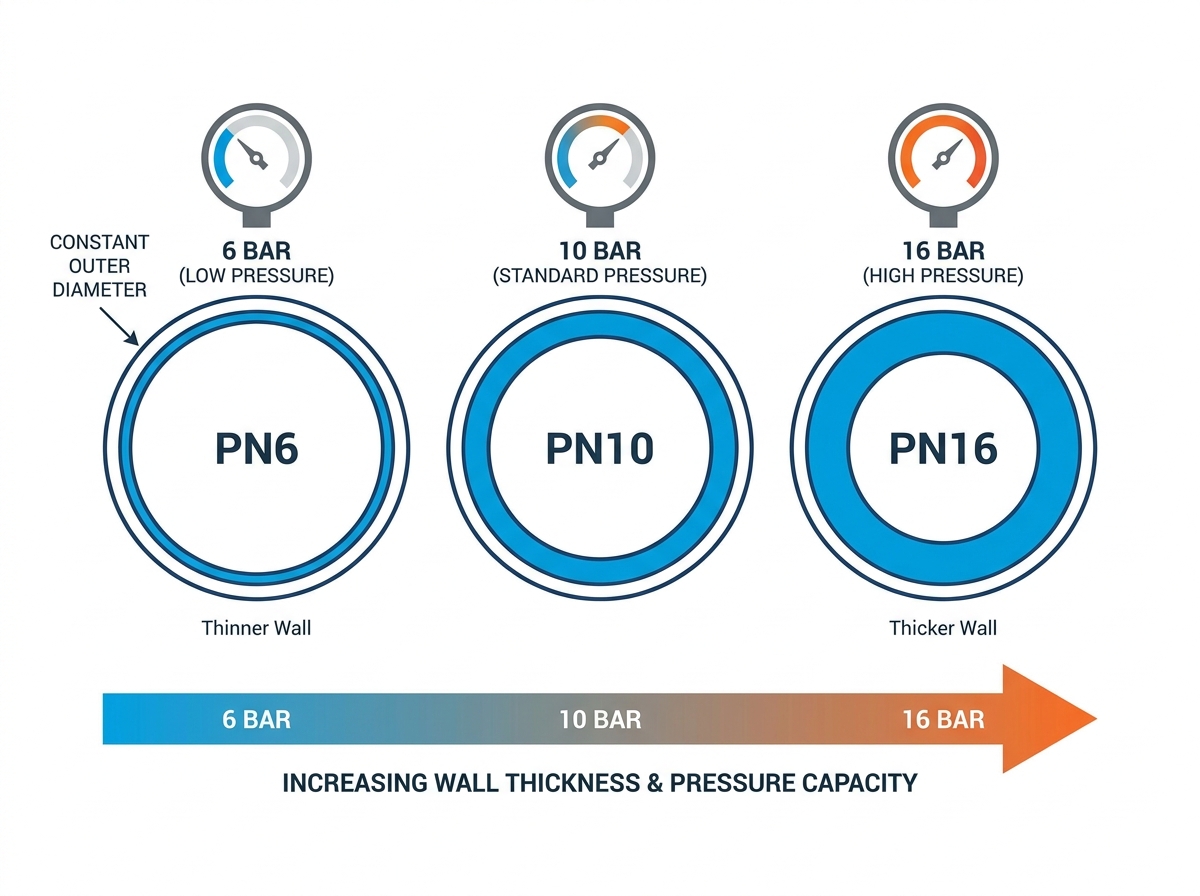
You can visualize the physical differences between pressure classes by examining pipe geometry. Higher PN ratings require significantly thicker pipe walls to handle increased stress. Engineers measure this relationship using the Standard Dimension Ratio (SDR). We calculate SDR by dividing the outer diameter by the wall thickness. A lower SDR number indicates a thicker wall. Crucially, the outer diameter remains constant across different pressure classes. This geometric consistency ensures you can integrate various pipes into standard fittings.
Trust in infrastructure relies heavily on manufacturing standards. Reliable PVC pipe specifications adhere to strict international frameworks. Leading regulatory bodies define these parameters carefully. You will frequently encounter ISO 1452 and EN 1452 standards during procurement. These frameworks guarantee baseline performance criteria regarding tensile strength and impact resistance. They establish a universal language for contractors globally. Procurement teams must verify these certifications to ensure regulatory compliance across municipal projects.
Decision-makers must map specific pipe features directly to field outcomes. Choosing the right class prevents operational failures downstream. We outline the primary classifications below.
PN Rating | Max Pressure (Bar) | Max Pressure (PSI) | Primary Use Case | Risk Profile |
|---|---|---|---|---|
PN6 | 6 Bar | ~87 PSI | Gravity drainage, rainwater collection | High vulnerability to pressure surges |
PN10 | 10 Bar | ~145 PSI | Mainline irrigation, commercial supply | Balanced cost/performance ratio |
PN16 | 16 Bar | ~232 PSI | High-pressure pumps, chemical dosing | Requires strict installation protocols |
The PN6 classification represents the most economical option for specific low-stress environments. These pipes handle a maximum of 6 bar. This equates to approximately 87 psi. They feature thinner walls compared to higher-rated counterparts. They offer excellent flow rates due to their larger internal diameters. You will find them easiest to handle during physical installation.
Engineers deploy PN6 pipes primarily in gravity-fed systems. Proven use cases include standard rainwater harvesting networks. They work exceptionally well for agricultural runoff channels. Contractors also use them for open-discharge drainage setups. These environments rely on natural elevation changes to move fluids. They rarely encounter active mechanical pumping forces.
However, implementation carries inherent risks. PN6 materials remain highly vulnerable to unexpected pressure surges. You must never connect them directly to high-pressure municipal mains. They lack the structural rigidity to withstand sudden water hammer events. Using them outside gravity-fed constraints often leads to immediate pipeline ruptures.
This mid-tier classification serves as the industry workhorse. A standard PN10 pipeline handles up to 10 bar of pressure safely. This translates to roughly 145 psi. It provides substantial structural integrity without excessive material costs. Most general contractors specify this rating for standard building projects.
Proven use cases cover a vast range of civil applications. You see them heavily utilized in mainline irrigation grids. They form the backbone of residential cold water supply networks. Light industrial facilities use them for basic fluid transport. They support moderate pumping systems effectively.
You should shortlist this class for standard operations. It offers the optimal balance of material cost and pressure tolerance. It handles typical municipal water pressure safely. You avoid the excessive costs associated with heavy-duty alternatives. It remains versatile enough for the vast majority of commercial applications.
Industrial projects demand superior material resilience. The PN16 classification delivers maximum durability for unplasticized polyvinyl chloride. These robust pipes manage up to 16 bar. This equals an impressive 232 psi. They feature very thick walls and low SDR values. This thickness restricts flow slightly but maximizes structural strength.
Proven use cases involve extreme mechanical stress. Engineers require them for high-pressure pumping stations. You find them across industrial water treatment plants. Chemical dosing lines rely on their robust walls. Deep-well submersible pump risers use them exclusively. They withstand aggressive environments reliably.
You shortlist PN16 when system failure poses severe safety hazards. It provides critical safety margins for continuous stress applications. Systems prone to aggressive fluid handling need this protection. It resists material fatigue better than any lower classification. It represents the gold standard for industrial fluid management.
Vendors frequently gloss over complex real-world physics during sales presentations. They highlight nominal ratings as absolute guarantees. True professionals understand that dynamic variables alter operational realities constantly. You must account for temperature shifts and kinetic energy to ensure safety. We focus on these hidden variables below.
Temperature acts as the primary derating factor. Polyvinyl chloride is a thermoplastic material. It loses structural rigidity as ambient or fluid temperatures increase. Manufacturers benchmark the nominal rating at 20°C. If your system exceeds this temperature, the safe working capacity plummets. For example, a standard 10 bar pipe operating at 40°C loses significant strength. Under these warmer conditions, it may safely handle only 6 bar of pressure. You must consult specific derating charts provided by manufacturers. Ignoring this thermal relationship guarantees eventual system fatigue and rupture.
Water hammer presents another severe operational threat. Engineers refer to this phenomenon as surge pressure. Sudden valve closures force moving fluids to stop instantly. Pump starts generate similar shockwaves. This kinetic energy transforms into massive static pressure spikes. A system operating normally at 5 bar might experience split-second spikes exceeding 15 bar. These transient waves travel through pipelines rapidly. They seek out the weakest structural points to release energy. You must design networks capable of absorbing these violent shocks.
We advise buyers to utilize a strict evaluation rule. You calculate the true PVC pipe pressure rating requirement using a three-part formula. First, determine the maximum dynamic pressure your pumps generate. Second, add a calculated surge allowance based on your valve closure speeds. Finally, apply the required temperature derating multiplier. You finalize your material selection only after completing this comprehensive arithmetic. This rigorous approach separates professional installations from amateur failures.
Perfect calculations mean nothing without flawless physical implementation. Downstream installation failures plague many civil engineering projects. These issues usually stem from a misunderstanding of pipeline geometry. You must supervise joining methods and component matching meticulously.
The Outer Diameter (OD) constant confuses many novice contractors. Industry standards mandate a uniform outer diameter across all pressure classes. A 110mm PN6 variant and a 110mm PN16 variant share the exact same OD. This allows them to fit into standard 110mm sockets universally. However, they feature vastly different Internal Diameters (ID). The high-pressure variant has much thicker walls pushing inward. You must account for this ID restriction when calculating flow rates and friction losses. Failing to do so causes severe pump cavitation.
Matching components determines total system viability. You create massive liabilities by mixing incompatible grades. The most common procurement mistake involves purchasing heavy-duty piping while skimping on accessories. A pipeline's true capacity strictly mirrors its weakest link. If you install 16 bar piping but use 6 bar rated ball valves, your entire system degrades to a 6 bar limit. You must audit every fitting, union, and flange carefully. They must meet or exceed the primary pipe classification.
Joining methods require rigorous oversight. Higher pressure systems demand absolute perfection during assembly. When installing heavy-duty networks, contractors must follow specific protocols.
Surface Preparation: Technicians must chamfer pipe edges and clean surfaces thoroughly using approved industrial primers.
Solvent Application: You must apply heavy-bodied solvent cement formulated specifically for high-pressure systems.
Cure Times: Technicians must observe extended curing periods before initiating pressure testing.
Mechanical Alternatives: For extreme industrial applications, precise mechanical flanging often replaces chemical cementing to prevent catastrophic blowouts.
Shortlisting the correct materials requires logical progression. You eliminate guesswork by following a structured procurement pathway. This checklist guides buyers toward secure and compliant purchasing decisions.
Step 1 requires defining precise operational limits. You must document the maximum expected fluid temperature throughout the year. Record the continuous static pressure your pumps will maintain. Identify potential surge events caused by automated valves or rapid pump cycling. Gather these metrics before contacting any vendor.
Step 2 demands strict compliance verification. You must verify the chosen supplier holds all relevant industry certifications. Check for ISO standards regarding manufacturing quality control. If the project involves potable water, demand WRAS certification or local equivalents. Do not accept uncertified materials regardless of budget constraints. Substandard manufacturing processes lead to invisible microscopic defects.
Step 3 focuses on actionable technical validation. We strongly recommend consulting with a certified hydraulic engineer before placing bulk orders. You must request comprehensive Technical Datasheets (TDS) from prospective manufacturers. Review their specific temperature derating curves. Compare their guaranteed surge allowances against your calculated system shocks. Taking these deliberate steps ensures your procurement perfectly matches the physical realities of your construction site.
Selecting between different pressure ratings is never about choosing "good, better, or best" materials. It requires matching exact material physics to your project's unique hydraulic reality. Understanding the fundamental differences between gravity-fed requirements and high-surge industrial networks ensures long-term infrastructure health. You must evaluate temperature impacts, mitigate water hammer, and maintain strict consistency across all system fittings.
We encourage you to prioritize engineering data over assumptions. Contact our technical sales engineering team today. Share your expected flow rates, maximum temperature data, and structural project specs. We will analyze your operational parameters and deliver a tailored, risk-averse recommendation and quote.
A: Continuous over-pressurization leads immediately to severe material fatigue. You will cause microscopic fractures to form along the pipe walls. These micro-fractures expand rapidly under fluctuating temperatures. This stress culminates in catastrophic bursting and extensive water damage. Furthermore, operating beyond published limits instantly voids all manufacturer warranties.
A: No, they utilize entirely different measurement frameworks. The "PN" system is a metric standard based strictly on bar pressure capacity. "Schedule" (such as 40 or 80) relies on an ASTM standard dictating specific wall thicknesses in inches. They are not directly interchangeable. You must consult engineering conversion charts before substituting one for the other.
A: Physically, it is entirely possible because their outer diameters match perfectly. However, engineered systems remain strictly limited by their weakest physical point. If you mix these classifications, you effectively down-rate the entire pipeline's safety threshold to the capacity of the lower-rated sections. We highly discourage this practice in commercial applications.


